
August 6, 2026
Power-Map Profiling helps users understand how they are perceived by their personal and professional networks through anonymous feedback based on professional and non-professional frameworks such as DISC, Social Styles, zodiac signs, and Power-Map animal archetypes.
.png)
We all move through life carrying an image of ourselves.
We know what we intend to express. We know the values we believe we represent. We know the effort we make to be helpful, ambitious, reliable, creative, supportive, strategic, or inspiring.
But there is often a gap between how we see ourselves and how others experience us.
That gap can influence our relationships, our career, our opportunities, our leadership style, our credibility, our confidence, and even the way we evolve as human beings.
This is where Power-Map Profiling comes in.
Power-Map Profiling allows users to “profile” other users by sharing their perception of them through simple, structured frameworks. These perceptions remain anonymous. They are not designed to judge, rank, expose, or criticize anyone. They are designed to help each person better understand the image they project to their personal and professional networks.
In other words, Power-Map Profiling acts like a mirror.
Not a harsh mirror.
Not a public scoreboard.
Not a personality test pretending to define who you are forever.
It is a reflective tool that helps you answer a powerful question:
“How do the people around me perceive me?”
Organize your contacts, profiles, and personal brand in one app built for the new multi-identity economy.

Power-Map Profiling is a feature that allows users to give anonymous feedback about how they perceive another person.
A user may be invited to profile someone based on different frameworks, including professional frameworks such as DISC and Social Styles, as well as more playful or symbolic frameworks such as zodiac signs and Power-Map animal archetypes.
The goal is simple: to help the recipient understand the impression they create.
This can be useful in many contexts:
A professional may want to know whether others see them as decisive, analytical, inspiring, reliable, collaborative, or creative.
A founder may want to understand whether their network sees them as visionary, practical, charismatic, organized, or resilient.
A manager may want to know whether their team experiences them as supportive, demanding, structured, flexible, or energizing.
A student, consultant, creator, salesperson, executive, freelancer, or entrepreneur may want to better understand the personal brand they are building through everyday interactions.
Power-Map Profiling turns subjective impressions into structured feedback.
It helps transform scattered opinions into a clearer self-awareness map.
One of the most important principles of Power-Map Profiling is anonymity.
The feedback given through profiling is anonymous because the purpose is not to create social pressure or personal conflict. The purpose is to help the recipient receive honest, useful signals about how they are perceived.
People often hesitate to give direct feedback, especially when it concerns personality, behavior, communication style, leadership, or social presence.
Anonymity makes feedback easier to share.
But anonymity also comes with responsibility.
Power-Map Profiling is not designed for mockery, revenge, gossip, harassment, or public judgment. It is designed to create a safe environment where perception can become a tool for growth.
The recipient does not receive feedback to feel labeled.
They receive it to reflect.
The goal is not to say, “This is who you are.”
The goal is to say, “This is how some people may experience you.”
That distinction matters.
Power-Map Profiling is based on a very important idea:
How others perceive you is not the full truth of who you are.
Perception is partial. It is influenced by context, culture, relationship history, communication habits, expectations, and even timing.
Someone may perceive you as reserved because they only know you in a formal work environment.
Someone else may perceive you as energetic because they know you in a creative or social setting.
A colleague may see you as structured.
A close friend may see you as spontaneous.
A client may see you as strategic.
A teammate may see you as supportive.
All of these perceptions can coexist.
Power-Map does not reduce a person to one box. Instead, it helps reveal the different images a person projects across their networks.
This is especially valuable because our personal and professional lives are increasingly connected. The way we are perceived can influence trust, collaboration, referrals, leadership opportunities, sales conversations, hiring decisions, partnerships, friendships, and personal growth.
Understanding perception does not mean becoming obsessed with what others think.
It means gaining awareness.
And awareness is one of the first steps toward evolution.
Power-Map Profiling is built on a deeply human principle:
There are no good or bad profiles.
There are no superior personalities.
There are no inferior styles.
There are no “right” ways to be human.
Some people are fast, bold, and direct.
Some are patient, thoughtful, and observant.
Some are warm, social, and expressive.
Some are precise, analytical, and structured.
Some are imaginative, unconventional, and visionary.
Some are steady, loyal, and deeply reliable.
Humanity is not powerful because everyone is the same.
Humanity is powerful because everyone is different.
Our differences create friendship, innovation, trust, humor, leadership, art, science, entrepreneurship, families, communities, and progress.
A world full of only one type of personality would be poor, fragile, and boring.
We need builders and dreamers.
We need leaders and listeners.
We need analysts and creators.
We need patient people and fast movers.
We need social connectors and quiet thinkers.
We need people who challenge, people who protect, people who invent, and people who care.
Power-Map Profiling is not about ranking those differences.
It is about helping people recognize them, understand them, and use them better.
When you understand how others perceive you, you can make better choices.
You may discover that people see you as more inspiring than you thought. That can give you confidence.
You may discover that people see you as more intimidating than you intended. That can help you soften your communication.
You may discover that people see you as highly reliable but not very visible. That can encourage you to speak up more.
You may discover that people see you as creative but sometimes scattered. That can help you add more structure to your ideas.
You may discover that people see you as kind and supportive, but not decisive enough. That can help you strengthen your leadership posture.
The goal is not to become someone else.
The goal is to become more conscious of your impact.
Power-Map Profiling helps you identify patterns. When multiple people perceive you in similar ways, that signal can become valuable. It may confirm a strength. It may reveal a blind spot. It may show a gap between your intention and your impact.
Growth does not always require dramatic transformation.
Sometimes, it begins with one simple realization:
“Now I understand how I come across.”
Power-Map includes professional profiling frameworks designed to help users understand how they may be perceived in work, leadership, collaboration, sales, management, entrepreneurship, and business relationships.
The goal is not to make a clinical assessment. It is not to diagnose personality. It is not to replace coaching, management feedback, or professional evaluation.
Instead, these frameworks offer accessible lenses to better understand communication style, working preferences, decision-making tendencies, and interpersonal dynamics.
DISC is one of the professional frameworks used in Power-Map to help describe how a person may be perceived in action.
The DISC model is commonly associated with four broad behavioral tendencies:
Dominance
People perceived through this lens often appear direct, results-oriented, confident, competitive, and comfortable making decisions. They may be seen as people who move fast, challenge obstacles, and focus on outcomes.
Influence
People perceived through this lens often appear expressive, enthusiastic, persuasive, optimistic, and socially engaging. They may be seen as people who create energy, build relationships, and motivate others.
Steadiness
People perceived through this lens often appear calm, loyal, patient, supportive, and reliable. They may be seen as people who bring stability, listen carefully, and create trust.
Conscientiousness
People perceived through this lens often appear precise, analytical, careful, organized, and quality-focused. They may be seen as people who value accuracy, structure, and well-founded decisions.
In Power-Map, DISC is useful because professional relationships are often shaped by behavior.
Do people experience you as decisive?
Do they see you as inspiring?
Do they feel supported by you?
Do they trust your analytical rigor?
Again, no DISC tendency is better than another.
A strong team needs all of them.
A company needs people who decide, people who connect, people who stabilize, and people who analyze. A person may also express different tendencies depending on the context.
Power-Map uses DISC as a mirror of perceived professional behavior, not as a permanent identity label.
Social Styles is another professional framework used in Power-Map. It focuses on how people are perceived in interpersonal situations, especially in communication, collaboration, leadership, negotiation, and teamwork.
The Social Styles framework is often organized around four major styles:
Driving Style
People perceived as Driving may come across as focused, assertive, fast-moving, practical, and goal-oriented. They often want progress, clarity, and results.
Expressive Style
People perceived as Expressive may come across as energetic, creative, spontaneous, enthusiastic, and relationship-driven. They often bring ideas, emotion, and momentum into conversations.
Amiable Style
People perceived as Amiable may come across as warm, cooperative, patient, diplomatic, and supportive. They often care about harmony, trust, and human connection.
Analytical Style
People perceived as Analytical may come across as precise, logical, cautious, thoughtful, and detail-oriented. They often value facts, structure, and careful reasoning.
Social Styles can be especially useful because many misunderstandings come from style differences.
A Driving person may see an Analytical person as too slow.
An Analytical person may see a Driving person as too impulsive.
An Expressive person may see an Amiable person as too reserved.
An Amiable person may see an Expressive person as too intense.
But none of these styles is wrong.
They simply operate differently.
Power-Map helps users understand how others experience their social and professional energy. That awareness can improve communication, leadership, sales, teamwork, and personal branding.
When you understand your perceived Social Style, you can adapt without betraying yourself.
You can communicate more clearly.
You can collaborate more intelligently.
You can better understand why some people connect with you instantly while others need a different approach.
Power-Map also includes non-professional frameworks. These are not designed to evaluate someone’s work style in a formal sense. They are more symbolic, playful, intuitive, and emotionally accessible.
They help people reflect on how they are perceived in a lighter way.
Not every insight has to be corporate.
Not every mirror has to be serious.
Sometimes, a symbolic profile can reveal something meaningful because it feels simple, memorable, and human.
Astrological signs are part of Power-Map’s non-professional profiling experience.
In this context, zodiac signs are not used as scientific proof of personality. They are used as a cultural and symbolic language that many people already understand.
People often associate zodiac signs with recognizable energies.
Aries may evoke boldness and initiative.
Taurus may evoke stability and sensuality.
Gemini may evoke curiosity and communication.
Cancer may evoke sensitivity and protection.
Leo may evoke confidence and radiance.
Virgo may evoke precision and service.
Libra may evoke harmony and aesthetics.
Scorpio may evoke intensity and depth.
Sagittarius may evoke freedom and exploration.
Capricorn may evoke ambition and discipline.
Aquarius may evoke originality and independence.
Pisces may evoke imagination and empathy.
In Power-Map, zodiac profiling is less about astrology itself and more about perception.
When someone associates you with a zodiac sign, they are often expressing a feeling: the energy you give off, the role you play in a group, the emotional tone people connect with you.
It is a playful way to ask:
“What kind of energy do people associate with me?”
For personal networks, this can feel more natural than a formal business framework. For professional networks, it can add a more human and memorable layer to how someone is perceived.
Power-Map also uses animal archetypes to make profiling more visual, emotional, and easy to understand.
Each animal represents a symbolic way people may experience someone’s personality, energy, or social behavior.
These animals are not rigid categories. They are metaphors.
A person may be perceived as one animal in a professional context and another in a personal context. They may also evolve over time.
The purpose is not to lock people into a cartoon identity.
The purpose is to make self-awareness easier, warmer, and more memorable.
The Panda Zen represents calm, kindness, emotional balance, and peaceful presence.
Someone perceived as a Panda Zen may be seen as gentle, reassuring, grounded, and easy to be around. They may create a sense of safety in groups. They may not need to dominate the room to have a strong impact.
The Panda Zen profile can be very powerful in personal relationships and professional environments where trust, patience, and emotional intelligence matter.
A Panda Zen may help others slow down, breathe, and reconnect with what matters.
Their strength is not speed.
Their strength is presence.
The Cheetah Turbo represents speed, ambition, action, and intensity.
Someone perceived as a Cheetah Turbo may be seen as fast-moving, energetic, competitive, and highly focused on progress. They may like momentum, opportunities, challenges, and rapid execution.
In professional settings, the Cheetah Turbo can be associated with sales energy, entrepreneurship, leadership, growth, and performance.
In personal settings, this profile may reflect someone who brings excitement, movement, and drive.
The Cheetah Turbo’s gift is acceleration.
They help things move forward.
Their challenge may be learning when to slow down, listen, and let others catch up.
The Wise Owl represents knowledge, perspective, observation, and thoughtful judgment.
Someone perceived as a Wise Owl may be seen as intelligent, calm, reflective, and insightful. They may not speak first, but when they do, people listen.
The Wise Owl is often associated with strategy, analysis, mentoring, wisdom, and long-term thinking.
In a professional network, this profile can reflect someone who brings clarity, expertise, and sound reasoning.
In a personal network, it may reflect someone people turn to for advice.
The Wise Owl’s strength is depth.
They help others see what is not obvious at first glance.
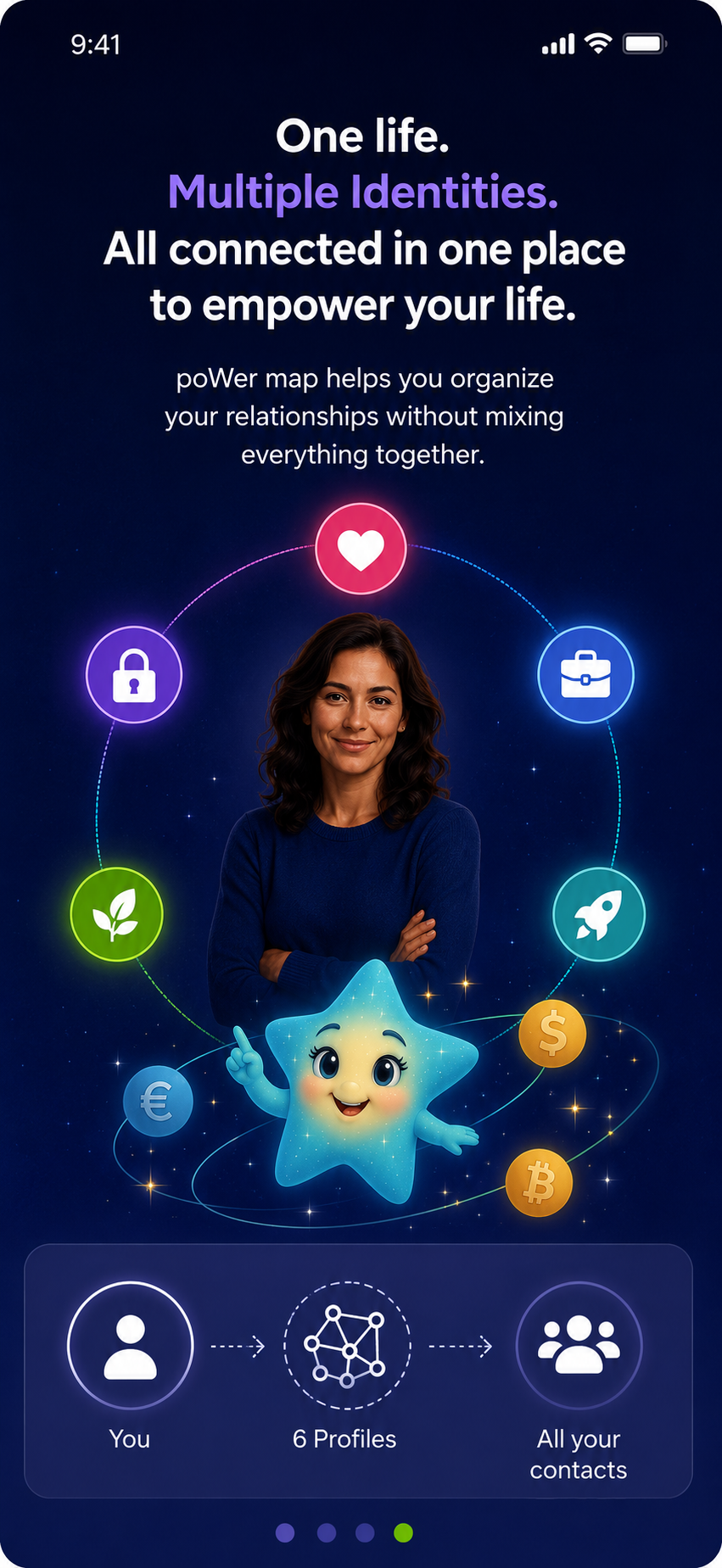
With our mobile app Power Map Contacts, organize your contacts, profiles, and identities in one app built for the multi-identity world.
Create personal, professional, or private profiles. Map your network. Take control of your personal brand.
The Supportive Otter represents connection, generosity, teamwork, and emotional warmth.
Someone perceived as a Supportive Otter may be seen as friendly, helpful, cooperative, and socially caring. They may naturally create bridges between people.
This profile can be especially valuable in communities, teams, families, and networks where trust and mutual support are essential.
In professional life, the Supportive Otter may be the person who helps collaboration happen.
In personal life, they may be the friend who checks in, listens, and brings people together.
Their strength is solidarity.
They remind us that success is not only individual.
The Clever Fox represents intelligence, adaptability, strategy, and resourcefulness.
Someone perceived as a Clever Fox may be seen as sharp, quick-thinking, persuasive, and able to find creative solutions. They may notice opportunities others miss.
In professional settings, this profile can be associated with negotiation, business development, strategy, entrepreneurship, marketing, or problem-solving.
In personal settings, the Clever Fox may be someone who always has a smart idea, a shortcut, or a plan.
Their strength is agility.
They know how to adapt to changing situations.
Their challenge may be making sure their intelligence is always experienced as trustworthy and constructive.
The Builder Beaver represents structure, discipline, reliability, and execution.
Someone perceived as a Builder Beaver may be seen as practical, hardworking, organized, and dependable. They may be the person who turns ideas into reality.
This profile is extremely valuable in professional environments because every vision needs builders.
The Builder Beaver is not just a planner.
They are a maker.
They create systems, processes, products, documents, operations, routines, and foundations.
In personal life, they may be perceived as someone others can count on.
Their strength is construction.
They build what others only imagine.
The Social Dolphin represents communication, empathy, playfulness, and social intelligence.
Someone perceived as a Social Dolphin may be seen as expressive, engaging, emotionally intelligent, and comfortable with people. They may naturally create positive social energy.
In professional settings, the Social Dolphin may shine in networking, sales, leadership, events, community building, client relationships, and public communication.
In personal settings, they may be the person who makes others feel included.
Their strength is connection.
They bring movement, warmth, and relational intelligence to the group.
The Social Dolphin reminds us that human success often depends on the ability to create trust and joy with others.
The Organized Ant represents discipline, teamwork, planning, and collective effort.
Someone perceived as an Organized Ant may be seen as structured, consistent, responsible, and highly reliable. They may pay attention to details and contribute steadily to shared goals.
This profile is especially powerful in complex professional environments where coordination matters.
The Organized Ant may not always seek the spotlight, but their contribution is essential.
They make systems work.
They help teams deliver.
They respect the importance of effort over time.
In personal life, they may be perceived as dependable, serious, and committed.
Their strength is consistency.
They prove that small actions, repeated with discipline, can create major results.
The Creative Hummingbird represents imagination, inspiration, sensitivity, and creative movement.
Someone perceived as a Creative Hummingbird may be seen as original, colorful, intuitive, and full of ideas. They may bring beauty, energy, and imagination into their environment.
In professional settings, the Creative Hummingbird can be associated with design, storytelling, innovation, branding, content creation, entrepreneurship, and vision.
In personal settings, they may be perceived as inspiring, artistic, surprising, or emotionally vibrant.
Their strength is creativity.
They help others see new possibilities.
The Creative Hummingbird reminds us that ideas can be light, fast, beautiful, and transformative.
The Patient Turtle represents resilience, wisdom, stability, and long-term progress.
Someone perceived as a Patient Turtle may be seen as calm, persistent, grounded, and thoughtful. They may not rush, but they continue moving forward.
This profile is powerful because many meaningful achievements require patience.
Careers are built over years.
Trust is built over time.
Personal growth is built through repetition.
Major life changes rarely happen overnight.
In professional life, the Patient Turtle may be someone who brings maturity, endurance, and perspective.
In personal life, they may be perceived as steady, loyal, and reassuring.
Their strength is perseverance.
They show that slow progress is still progress.
One of the strengths of Power-Map Profiling is that it combines serious professional frameworks with more playful personal ones.
That combination matters because human identity is not purely professional.
We are not only job titles, resumes, skills, and performance indicators.
We are also energy, emotion, style, humor, symbols, stories, relationships, and memories.
A professional framework such as DISC may help someone understand how they are perceived at work.
A Social Styles profile may help someone improve communication.
A zodiac sign may reveal the emotional energy others associate with them.
An animal archetype may make that perception easier to remember and discuss.
Together, these frameworks create a richer picture.
Not a perfect picture.
Not a final truth.
But a useful mirror.
In personal life, Power-Map Profiling can help people better understand the role they play among friends, family, communities, and social circles.
Are they perceived as the calm one?
The funny one?
The wise one?
The ambitious one?
The creative one?
The loyal one?
The organizer?
The connector?
The person who always brings energy?
The person who always brings perspective?
These perceptions can be deeply meaningful.
They can help someone recognize strengths they may underestimate.
They can also help someone notice gaps. For example, a person may want to be perceived as supportive but discover that others mainly see them as distant or overly busy. That does not mean they are a bad person. It simply gives them a chance to reconnect with intention.
Personal growth often begins when we understand the emotional footprint we leave behind.
In professional life, Power-Map Profiling can help users understand their perceived reputation.
This matters because professional opportunities are often influenced by perception.
People recommend those they trust.
They hire those they understand.
They promote those they believe are ready.
They follow leaders who project clarity.
They buy from people who create confidence.
They partner with people whose strengths are visible.
Power-Map Profiling can help professionals identify how their network sees them.
Are they perceived as strategic?
Reliable?
Creative?
Analytical?
Commercial?
Empathetic?
Visionary?
Operational?
Influential?
Structured?
This kind of feedback can support personal branding, leadership development, sales effectiveness, career mobility, and relationship-building.
It can also help people understand whether the image they project matches the opportunities they want to attract.
Power-Map Profiling should not be treated as a final judgment.
It is a starting point for reflection.
A profile can help someone ask better questions:
Why do people see me this way?
Is this perception aligned with who I want to become?
Is this a strength I should embrace more?
Is this a blind spot I should explore?
Do I show different sides of myself in different contexts?
How can I communicate more clearly?
How can I use my natural style without limiting myself?
The most useful profile is not the one that flatters you.
The most useful profile is the one that helps you understand yourself better.
Power-Map Profiling is built around a human-centered vision.
People are complex.
People evolve.
People contain contradictions.
People cannot be reduced to a single framework.
But frameworks can help us begin a conversation.
They give language to things we often feel but do not know how to express.
They help transform perception into insight.
They help people see themselves not only through their own intentions, but also through the experience of others.
And when used with kindness, humility, and curiosity, that can be powerful.
Power-Map Profiling helps users better understand how they are perceived by their personal and professional networks.
Through anonymous feedback and accessible frameworks, it gives recipients a clearer view of the image they project.
It is not about judgment.
It is not about ranking.
It is not about deciding who is better or worse.
It is not about forcing people into categories.
It is about awareness.
There are no good or bad profiles.
There are only different ways of being human.
Some people are fast. Some are calm.
Some are analytical. Some are emotional.
Some are structured. Some are creative.
Some are social. Some are reflective.
Some lead through action. Some lead through wisdom.
Some inspire, some protect, some build, some connect.
These differences are not flaws.
They are the richness of humanity.
Power-Map Profiling helps each person better understand their reflection in the eyes of others, so they can grow with more clarity, confidence, and purpose.


