
August 6, 2026
From Lady Gaga to The Weeknd, famous artists have long managed multiple identities. Generation Alpha may become the first generation where this practice becomes the norm for everyone.

When most people think about identity, they imagine something fixed.
You are born with a name.
You build a career.
You create relationships.
You develop a reputation.
And that identity follows you throughout life.
But reality has always been more complex.
For decades, some of the world's most successful artists, actors, musicians, athletes, authors, and creators have built global careers under names that are completely different from the names on their passports.
Millions know Lady Gaga.
Far fewer know Stefani Germanotta.
Millions know Eminem.
Far fewer know Marshall Mathers.
Millions know The Weeknd.
Far fewer know Abel Tesfaye.
These individuals are not hiding their identities.
They are managing them.
In many ways, they were early pioneers of something that is becoming increasingly common for everyone: the ability to operate across multiple identities, communities, audiences, and networks.
Today, millions of people simultaneously live several lives:
Each role has its own audience.
Each role has its own reputation.
Each role has its own relationships.
This shift is creating what many experts increasingly describe as the Multi-Identity Economy.
Before exploring what this means for the future, let's look at 100 famous examples.
For decades, celebrities were among the few people who actively managed multiple identities.
Today, millions of ordinary people do exactly the same thing.
A consultant may also be a startup founder.
A teacher may also be a podcaster.
A software engineer may also be a creator.
A student may also be an influencer.
The digital world has made identity fluid.
The result is that personal branding is becoming a critical life skill.
What celebrities understood decades ago is now becoming relevant for everyone.
Your identity is no longer a single profile.
It is a portfolio.
Organize your contacts, profiles, and personal brand in one app built for the new multi-identity economy.

As AI, social media, remote work, creator economies, freelancing, and entrepreneurship continue to expand, people are increasingly operating across multiple networks.
Managing those identities effectively is becoming a competitive advantage.
The future will not belong to people with the largest networks.
It will belong to people who can effectively organize, protect, and activate multiple networks attached to multiple identities.
Because in the digital age, your contacts are not just contacts.
They are the living map of who you are.
And who you might become.
For centuries, identity was relatively simple.
You were born with a name.
You grew up in a neighborhood.
You attended a school.
You built a career.
Most people operated under a single public identity for their entire lives.
Generation Alpha is changing that model forever.
Born between approximately 2010 and 2025, Generation Alpha is the first generation growing up in a world where digital identities exist alongside physical identities from the very beginning of life.
For them, having multiple identities may become as natural as having multiple social circles.
And this shift could fundamentally transform education, careers, entrepreneurship, privacy, and human relationships.
Welcome to the age of the Multi-Identity Generation.
Generation Alpha follows Generation Z.
Its oldest members are now teenagers.
Its youngest members are still being born.
What makes Generation Alpha unique is not simply technology.
Millennials witnessed the birth of social media.
Generation Z grew up with smartphones.
Generation Alpha is growing up with artificial intelligence.
This distinction matters.
For the first time in history, an entire generation will interact daily with technologies capable of creating content, conversations, images, videos, music, and even virtual personalities.
They are not merely consuming the internet.
They are co-creating it.
Previous generations typically maintained one primary public identity.
A student became an employee.
An employee became a manager.
A manager became a retiree.
Identity evolved slowly.
Generation Alpha's identity evolves continuously.
A 13-year-old today may simultaneously be:
Each environment creates a different version of the same person.
Each environment develops its own reputation.
Each environment builds its own relationships.
The result is a generation learning to navigate multiple identities before entering adulthood.
Historically, becoming an artist required significant resources.
You needed:
Artificial intelligence is eliminating many of these barriers.
Today, a teenager can use AI to create:
Tomorrow, millions of people may become creators.
Some will create under their real names.
Others will adopt pseudonyms.
Some may operate multiple creative brands simultaneously.
Just as musicians once adopted stage names, Generation Alpha may routinely create several digital identities optimized for different audiences and projects.
The creator economy is evolving into an identity economy.
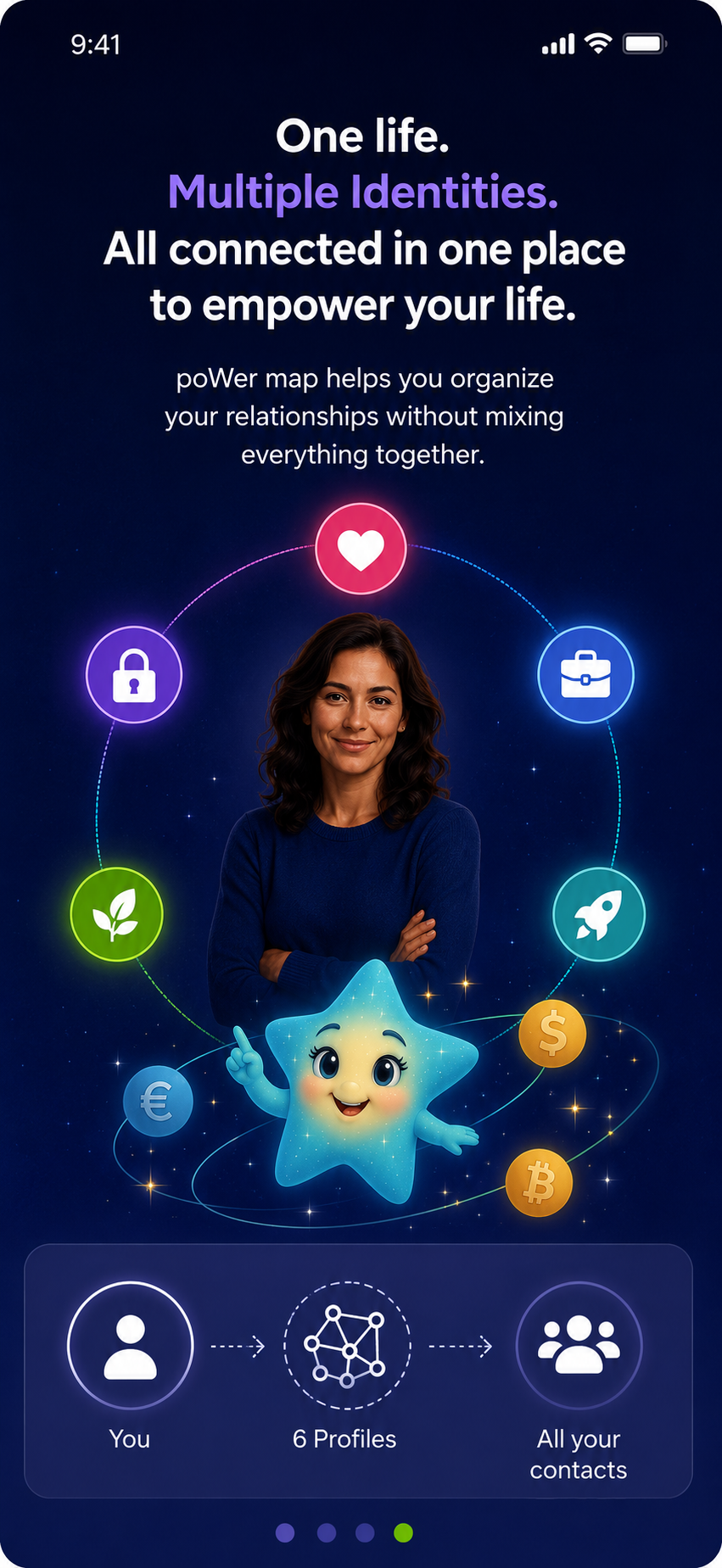
With our mobile app Power Map Contacts, organize your contacts, profiles, and identities in one app built for the multi-identity world.
Create personal, professional, or private profiles. Map your network. Take control of your personal brand.
Many parents today publish thousands of images of their children online before those children are old enough to understand the consequences.
Generation Alpha may choose a different path.
Instead of exposing their real identity everywhere, they may increasingly create protective layers between their private and public lives.
Imagine a teenager who:
This is not deception.
It is compartmentalization.
The same way authors use pen names.
The same way artists use stage names.
The same way celebrities separate public and private lives.
In the future, digital doubles may become a normal tool for privacy protection.
Previous generations learned:
Generation Alpha may need a new skill.
Identity literacy.
Identity literacy means understanding:
These skills may become just as important as financial literacy.
Because in a digital world, identity itself becomes an asset.
Online harassment has become one of the defining challenges of the digital era.
Many creators, journalists, activists, and influencers experience attacks because their public and private lives are too easily connected.
Identity separation offers a potential solution.
By creating boundaries between:
individuals can reduce their exposure to unwanted attention.
This does not eliminate harassment.
But it can reduce its impact.
Future generations may view identity separation as a basic digital safety practice.
Much like using strong passwords today.
The rise of multiple identities is not without challenges.
Identity fragmentation can create new risks.
Young people may feel pressure to maintain several personas simultaneously.
Different identities may compete with each other.
Some individuals may become disconnected from their authentic selves.
Artificial intelligence introduces additional complications.
AI can generate:
Distinguishing between authentic and artificial identities will become increasingly difficult.
The challenge of the next decade will not simply be creating identities.
It will be verifying them.
For centuries, wealth was associated with physical assets.
Then financial assets became dominant.
Later, knowledge became a competitive advantage.
Generation Alpha may witness the rise of a new form of capital:
Identity Capital.
Identity Capital includes:
A teenager with a trusted online community may possess opportunities that previous generations could not access until much later in life.
Identity will increasingly influence:
The individuals who learn to manage identity capital effectively may gain significant advantages.
As people accumulate multiple identities, they also accumulate multiple networks.
Managing these relationships becomes increasingly complex.
This is where a new discipline begins to emerge:
Identity Relationship Management (IRM).
IRM focuses on helping individuals:
In many ways, IRM may become for individuals what CRM became for companies.
A framework for managing one of their most valuable assets.
Their relationships.
Artists were among the first people to understand the power of multiple identities.
Lady Gaga understood it.
David Bowie understood it.
The Weeknd understands it.
What was once reserved for celebrities is becoming accessible to everyone.
Generation Alpha may become the first generation to grow up expecting multiple identities as a normal part of life.
Not because they are pretending to be someone else.
But because modern life increasingly requires different versions of ourselves.
The future may belong not to people with the most followers.
Nor to those with the most connections.
But to those who can successfully manage, protect, and activate the networks attached to every version of themselves.
Generation Alpha will not simply inherit the digital world.
They will redefine what identity means within it.
The 100 celebrities above reveal a simple truth.
The concept of multiple identities is not new.
Artists, actors, athletes, creators, and entrepreneurs have been practicing it for decades.
What is new is that the rest of the world is beginning to experience the same phenomenon.
The future of personal branding is not about creating a single perfect identity.
It is about understanding, managing, and growing the many identities that already exist within us.
One person.
Multiple identities.
Multiple worlds.
One life.


