
August 6, 2026
CRM helped companies manage customers. IRM helps individuals manage relationships across multiple identities. Discover why the future of networking, reputation, and opportunity may be built around Identity Relationship Management.
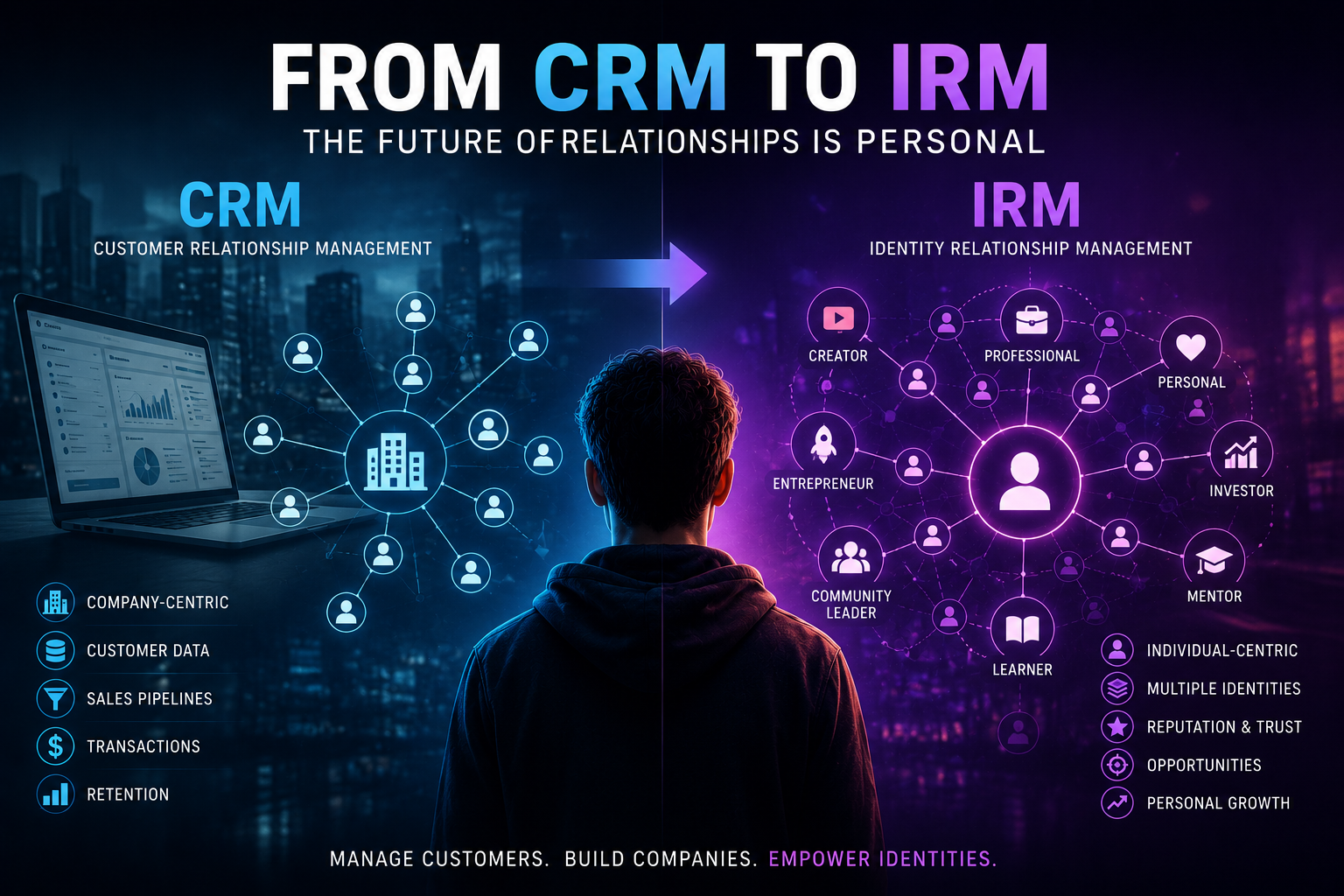
For more than four decades, one software category has quietly powered the modern economy.
Customer Relationship Management.
CRM transformed the way organizations manage relationships.
Before CRM, customer information was scattered across notebooks, spreadsheets, and individual salespeople's memories.
After CRM, relationships became assets that could be measured, optimized, and scaled.
Companies learned an important lesson:
Relationships create value.
Today, another transformation is beginning.
But this time, the customer is no longer at the center.
The individual is.
Welcome to the transition from CRM to Identity Relationship Management (IRM).
The success of CRM was based on a simple idea.
Every customer interaction matters.
Every email.
Every meeting.
Every opportunity.
Every relationship.
Platforms such as Salesforce, HubSpot, Microsoft Dynamics, and others helped organizations centralize and activate this information.
CRM became one of the largest software categories in history.
Why?
Because relationships are economic assets.
The better a company understands its relationships, the greater its ability to create value.
This principle remains true today.
But the center of gravity is shifting.
For most of history, organizations were the primary generators of economic value.
Today, individuals increasingly operate as platforms themselves.
A single person may simultaneously be:
Each role creates relationships.
Each role develops reputation.
Each role generates opportunities.
Each role contributes to an expanding personal ecosystem.
Individuals are no longer simply participants in networks.
They are becoming network operators.
Organize your contacts, profiles, and personal brand in one app built for the new multi-identity economy.

CRM was designed for organizations.
Its purpose is to answer questions such as:
These questions remain important.
But they do not address a growing challenge faced by individuals.
How do I manage relationships across multiple identities?
Consider a modern professional.
On LinkedIn they may be a consultant.
On YouTube they may be a creator.
On Discord they may be a community moderator.
On Substack they may be a writer.
On weekends they may be a volunteer.
Each identity generates a different network.
Each network contains different opportunities.
Traditional CRM systems were never designed to manage this complexity.
Identity Relationship Management (IRM) is a new discipline focused on helping individuals organize, understand, and activate relationships across multiple identities.
Where CRM manages customer relationships, IRM manages identity relationships.
CRM asks:
"How can a company better understand its customers?"
IRM asks:
"How can an individual better understand the relationships attached to every version of themselves?"
This distinction changes everything.
Most people no longer live under a single identity.
IRM allows individuals to separate:
Each identity can evolve independently while remaining connected to the broader individual.
Privacy is becoming one of the most valuable resources of the digital age.
IRM enables selective visibility.
Not everyone should have access to every identity.
Future digital systems will increasingly allow individuals to determine:
Not all relationships create equal value.
Some relationships generate opportunities.
Some generate trust.
Some generate learning.
Some generate influence.
IRM introduces a new layer of relationship analytics focused on human capital rather than customer value.
Every identity develops its own reputation.
A creator reputation may differ significantly from a professional reputation.
An entrepreneur reputation may differ from a community reputation.
IRM helps individuals monitor and manage those reputational assets.
The most valuable opportunities rarely come from strangers.
They emerge through networks.
The ability to understand relationships across multiple identities may reveal opportunities that would otherwise remain invisible.
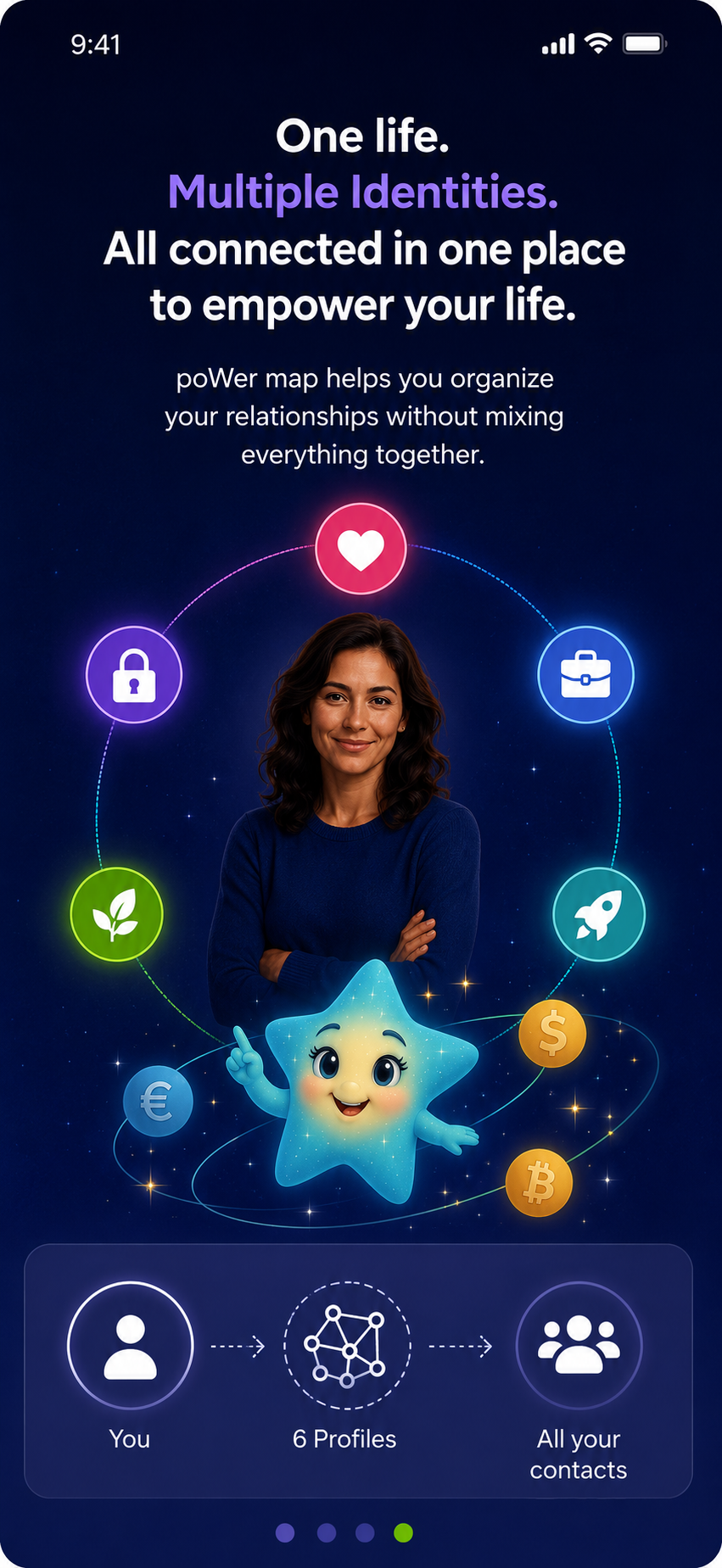
With our mobile app Power Map Contacts, organize your contacts, profiles, and identities in one app built for the multi-identity world.
Create personal, professional, or private profiles. Map your network. Take control of your personal brand.
CRM helped companies understand customer capital.
IRM introduces a broader concept.
Identity Capital.
Identity Capital includes:
These assets increasingly influence careers, businesses, investments, and social mobility.
In many industries, Identity Capital is becoming as important as financial capital.
Generation Alpha is growing up in a world where multiple identities are normal.
A teenager today may simultaneously be:
For this generation, identity fragmentation is not a problem.
It is simply reality.
As these individuals enter the workforce, demand for identity-centric tools will increase dramatically.
The next generation may never understand why people once tried to manage every relationship through a single identity.
Artificial intelligence is accelerating this transition.
Individuals can now create:
In the future, people may manage dozens of identities simultaneously.
Some human.
Some AI-assisted.
Some entirely digital.
The complexity of these ecosystems will require new tools and new frameworks.
IRM may become one of them.
The evolution may not stop at Identity Relationship Management.
If identity becomes a form of capital, individuals may eventually require tools to manage it as an asset.
This leads to a future concept:
Identity Asset Management (IAM).
Just as investors manage financial portfolios, future individuals may manage portfolios of:
The progression becomes clear:
CRM managed customer assets.
IRM manages identity relationships.
IAM may manage identity assets.
The CRM revolution transformed organizations.
The IRM revolution may transform individuals.
As the economy becomes increasingly driven by creators, communities, personal brands, and AI-assisted work, people will need better ways to manage the networks attached to every version of themselves.
The future will not belong solely to companies that understand their customers.
It will also belong to individuals who understand their identities.
Because in the emerging Multi-Identity Economy, the most valuable relationship you manage may no longer be with a customer.
It may be with every version of yourself.


