
August 6, 2026
Heat maps are powerful tools to visualize intensity, concentration, and patterns. But when organizations need to understand people, relationships, influence, trust, and opportunities, visual hotspots are not enough. Power Map believes the future belongs to relationship intelligence: a more contextual, ethical, and actionable way to map networks.
.jpg)
Heat maps are everywhere.
They are used in analytics dashboards, websites, sales reports, geographic analysis, risk matrices, product design, customer behavior studies, and business intelligence tools.
Their promise is simple: turn complexity into visual clarity.
Instead of reading thousands of rows in a spreadsheet, users can see intensity through color. Areas with more activity, higher risk, stronger concentration, or greater opportunity become instantly visible.
That is why heat maps are useful.
They help people see patterns faster.
But at Power Map, we believe heat maps also have a major limitation.
They show where intensity exists.
They do not explain why it matters.
They show concentration.
They do not reveal relationships.
They show hotspots.
They do not show trust, influence, context, or opportunity.
This distinction is essential.
Because in modern business, the most valuable maps are not only maps of activity.
They are maps of relationships.
Organize your contacts, profiles, and personal brand in one app built for the new multi-identity economy.

A heat map is a data visualization that uses color to represent the intensity, frequency, value, or concentration of information.
The idea is simple: the stronger the value, the stronger the color.
A heat map can show where users click on a website.
It can show which regions generate the most revenue.
It can show where customer demand is concentrated.
It can show which risks are most critical.
It can show which products perform best across segments.
It can show where operational pressure is building.
Heat maps are popular because they are easy to understand.
Humans are visual. We process color faster than rows of numbers. A well-designed heat map can help a team understand a complex dataset in seconds.
For executives, heat maps are useful because they compress information.
For analysts, they reveal patterns.
For product teams, they expose behavior.
For sales teams, they highlight territories.
For risk teams, they prioritize attention.
In short, heat maps are excellent tools for making invisible intensity visible.
But intensity is not intelligence.
The popularity of heat maps comes from three strengths.
First, heat maps are intuitive. You do not need to be a data scientist to understand that darker or warmer colors usually mean “more,” “stronger,” or “higher priority.”
Second, heat maps are fast. They help teams avoid endless tables and quickly identify where they should look first.
Third, heat maps are flexible. They can be used for geography, web behavior, customer activity, sales performance, risk, operations, HR, marketing, and many other business contexts.
This flexibility explains why heat maps have become part of the modern business language.
They are not just charts.
They are decision shortcuts.
But shortcuts can also be dangerous when they hide too much context.
The biggest strength of a heat map is also its biggest weakness: simplification.
A heat map reduces complexity into color.
That is useful when the objective is to locate intensity. But it becomes limiting when the objective is to understand meaning.
A red zone may look important. But why is it red?
A low-intensity area may look irrelevant. But is it really?
A hotspot may attract attention. But is it profitable, strategic, risky, or temporary?
A cold zone may be ignored. But could it hide future potential?
A heat map tells you where to look.
It does not tell you what to understand.
That is why heat maps must be used carefully in business environments where decisions depend on context, relationships, timing, trust, and human behavior.
One of the most common mistakes with heat maps is confusing volume with value.
A region with many contacts is not necessarily a strategic region.
A customer segment with many interactions is not necessarily the most profitable.
A website area with many clicks is not necessarily delivering conversion.
A sales territory with high activity is not necessarily creating trust.
A network with many connections is not necessarily influential.
Volume can be useful.
But value is different.
Value depends on quality, timing, relevance, trust, influence, and opportunity.
In relationship-driven businesses, the most important person in a network is not always the most visible one.
The strongest opportunity is not always located in the hottest zone.
And the most valuable relationship is not always the one with the most interactions.
This is why Power Map believes that relationship intelligence must go beyond heat maps.
Heat maps are excellent at showing patterns.
But relationships are not just patterns.
A relationship has history.
A relationship has trust.
A relationship has context.
A relationship has reciprocity.
A relationship has emotional memory.
A relationship has influence.
A relationship has potential.
A heat map can show that a sales team has many contacts in a specific account.
But it cannot show which contact trusts the team, who influences the decision, who blocks the deal, who used to work with whom, who can introduce whom, or which relationship should be activated first.
A heat map can show that a recruiter has many candidates in a market.
But it cannot show which candidate is ready to move, who trusts the recruiter, who belongs to which community, or who can refer high-quality talent.
A heat map can show that a consultant has many former clients in one industry.
But it cannot show which former client could become a sponsor, which project created strong credibility, or which relationship can open the next opportunity.
This is the gap between data visualization and relationship intelligence.
A beautiful heat map can make a team feel informed.
But a visually compelling chart is not always a reliable decision tool.
Colors can create false confidence.
Hotspots can exaggerate importance.
Poor data quality can produce misleading patterns.
Outdated information can distort reality.
The wrong color scale can change perception.
Aggregated data can hide critical nuance.
This matters because leaders often make decisions quickly.
When a heat map looks clear, people may stop asking questions.
But in strategy, sales, consulting, recruiting, and business development, the best questions are often hidden behind the colors.
Why is this area hot?
Who is driving the activity?
What changed recently?
Is this signal reliable?
Is this relationship strong or weak?
Is the opportunity real or only visible?
What action should we take next?
Power Map’s point of view is simple:
A heat map should start a conversation.
It should not end it.
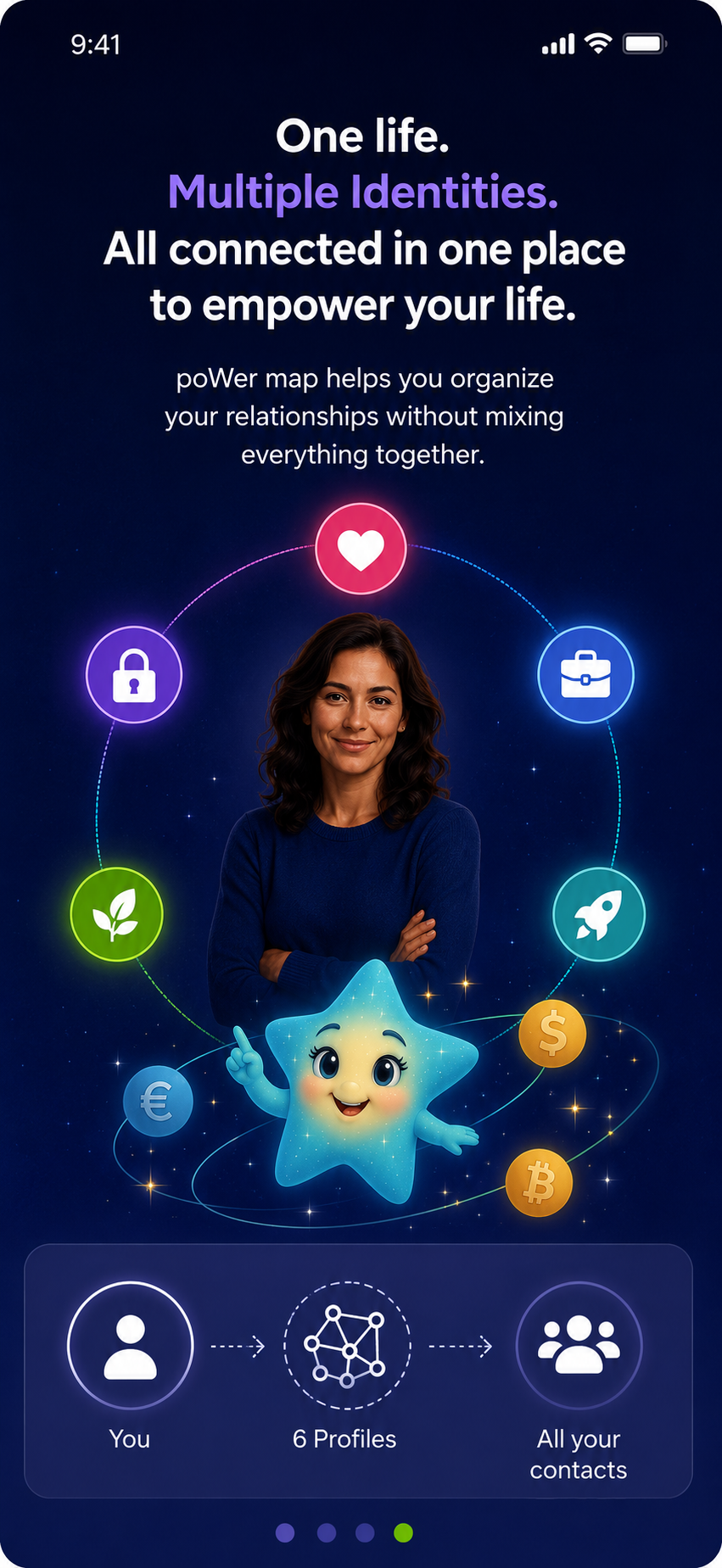
With our mobile app Power Map Contacts, organize your contacts, profiles, and identities in one app built for the multi-identity world.
Create personal, professional, or private profiles. Map your network. Take control of your personal brand.
A heat map answers one question:
Where is intensity concentrated?
A power map answers a different question:
How do people, relationships, influence, and opportunities connect?
That difference changes everything.
A heat map is useful when you want to visualize density.
A power map is useful when you want to understand a network.
A heat map helps identify hotspots.
A power map helps identify pathways.
A heat map shows what is active.
A power map shows who matters, why they matter, and how relationships can create action.
This is why Power Map focuses on relationship intelligence.
We believe the future of professional tools will not be limited to showing activity. It will be about helping people understand their relationships, manage multiple identities, activate trusted networks, and turn relationship capital into opportunities.
A power map is a visual and strategic representation of relationships, influence, context, and opportunity.
It can help answer questions such as:
Who are the key people in this network?
Who has influence?
Who has trust?
Who can introduce us?
Who is connected to whom?
Who knows the client?
Who supports the opportunity?
Who may block the decision?
Who belongs to which identity, role, or community?
What relationship should be activated next?
Unlike a heat map, a power map does not only represent intensity.
It represents meaning.
This makes it especially useful for professionals whose success depends on relationships.
Consultants.
Sales directors.
Recruiters.
Advisors.
Solopreneurs.
Fractional executives.
Founders.
Business developers.
Community builders.
Investors.
For these professionals, the challenge is not simply to know where activity happens.
The challenge is to understand which relationships can create trust, relevance, and opportunity.
At Power Map, we believe relationships are among the most valuable assets in professional life.
But most people do not manage them as assets.
They store contacts in their phone.
They collect connections on LinkedIn.
They save business cards.
They use spreadsheets.
They rely on memory.
They mix personal and professional networks.
They lose context when they change jobs.
They forget who introduced whom.
They miss opportunities because relationships are not structured.
This is not a small problem.
In a world where careers are becoming less linear and more people manage multiple professional identities, relationship capital becomes increasingly strategic.
A person may be an employee, advisor, consultant, investor, mentor, creator, founder, and board member at different moments of their career.
Each identity comes with a different network.
A traditional contact list cannot manage that complexity.
A heat map cannot explain it.
A relationship intelligence platform can.
Relationship intelligence is not only about seeing data.
It is about understanding context and taking better action.
A true relationship intelligence system should help users answer questions like:
Which relationships are strong?
Which ones are dormant but valuable?
Which contacts belong to which professional identity?
Which communities are strategically important?
Which relationships can generate introductions?
Which contacts are linked to specific opportunities?
Which people should I reconnect with?
Which network is underdeveloped?
Which relationship carries trust?
This is more advanced than a heat map.
A heat map can help visualize concentration. Relationship intelligence helps prioritize action.
That is the difference between seeing and knowing.
Sales teams often use heat maps to understand territories, pipeline distribution, customer concentration, or account activity.
This is useful.
But complex sales are rarely won because a region looks hot on a dashboard.
They are won because the right people trust the right people at the right moment.
In enterprise sales, one deal may involve economic buyers, technical buyers, influencers, blockers, procurement teams, legal teams, consultants, partners, and former colleagues.
A sales heat map may show account activity.
But a relationship map can show the buying committee.
It can reveal who knows whom, who has credibility, who can open a door, and who can help move the deal forward.
For sales directors, this is the difference between activity management and opportunity intelligence.
Consulting is a relationship business.
Clients do not buy only expertise. They buy trust, credibility, delivery confidence, and reputation.
A heat map may show which industries, geographies, or accounts generate the most consulting activity.
But it cannot explain the relationship history behind those opportunities.
Who sponsored the first project?
Who trusted the team during a crisis?
Who moved to another company?
Who can become a reference?
Who could introduce the firm to a new executive committee?
Which former client relationship is still warm?
Consultants need more than activity charts.
They need relationship memory.
Power Map is built around that idea: professional opportunities are often hidden inside relationship history.
Recruiters can use heat maps to visualize candidate density, market demand, skill concentration, or hiring activity.
But recruiting is not only about density.
The best candidates are often not actively looking.
The best referrals often come from trusted relationships.
The best hiring signals often come from communities.
The best opportunities often come from timing.
A heat map can show where talent is located.
Relationship intelligence can show who trusts the recruiter, who belongs to which community, who can refer whom, and which relationship should be reactivated.
In recruiting, the strongest asset is not only the database.
It is the network.
Traditional CRMs were designed for companies.
But individuals now need their own relationship systems.
A consultant needs to separate clients, partners, prospects, alumni, experts, and friends.
A solopreneur needs to manage customers, collaborators, suppliers, communities, and referrals.
A fractional executive needs to manage several companies, boards, investors, founders, and operators.
A sales leader needs to manage executive relationships across markets.
A recruiter needs to manage candidates, clients, hiring managers, and talent communities.
All of them need more than a heat map.
They need a personal CRM built around context, identity, and relationship intelligence.
That is where Power Map comes in.
Power Map does not reject heat maps.
Heat maps are valuable.
They help users see concentration.
They reveal patterns.
They simplify large datasets.
They support faster analysis.
They can guide attention.
But they should not be confused with strategy.
A heat map can show where something is happening.
It cannot fully explain what should be done next.
For Power Map, heat maps are one layer of intelligence.
Relationship context is another.
Influence is another.
Trust is another.
Identity is another.
Opportunity is another.
The future is not about choosing between heat maps and power maps.
It is about combining visual clarity with relationship intelligence.
The next generation of professional tools will not simply tell users where activity is concentrated.
They will help users understand what that activity means.
They will show not only hotspots, but opportunity paths.
They will connect people, roles, identities, relationships, skills, and timing.
They will help professionals make better decisions about who to contact, when to reconnect, where to invest energy, and how to activate their network ethically.
This is the future Power Map is building toward.
A future where contacts are not just stored.
They are understood.
A future where networks are not just collected.
They are structured.
A future where relationships are not just remembered.
They are activated with context and respect.
Heat maps are powerful because they make intensity visible.
But business does not run on intensity alone.
Business runs on trust.
Careers run on relationships.
Opportunities move through networks.
Influence depends on context.
Growth often begins with one meaningful connection.
That is why Power Map believes heat maps are useful, but incomplete.
They are excellent tools for seeing where activity is concentrated.
But when the real question is about people, trust, influence, identity, and opportunity, professionals need more.
They need relationship intelligence.
They need context.
They need a map that does not only show where things are hot, but why they matter and what to do next.
That is the difference between a heat map and a power map.
And that is why Power Map exists.
See your network. Understand your relationships. Turn relationship capital into opportunity.


