
September 4, 2026
Discover the 10 best serious games for finding a job in 2026. From gamified assessments and cognitive challenges to AI-powered career progression, compare the top platforms for candidates and employers—and see how poWermap turns skills, relationships and professional identity into a long-term career game.
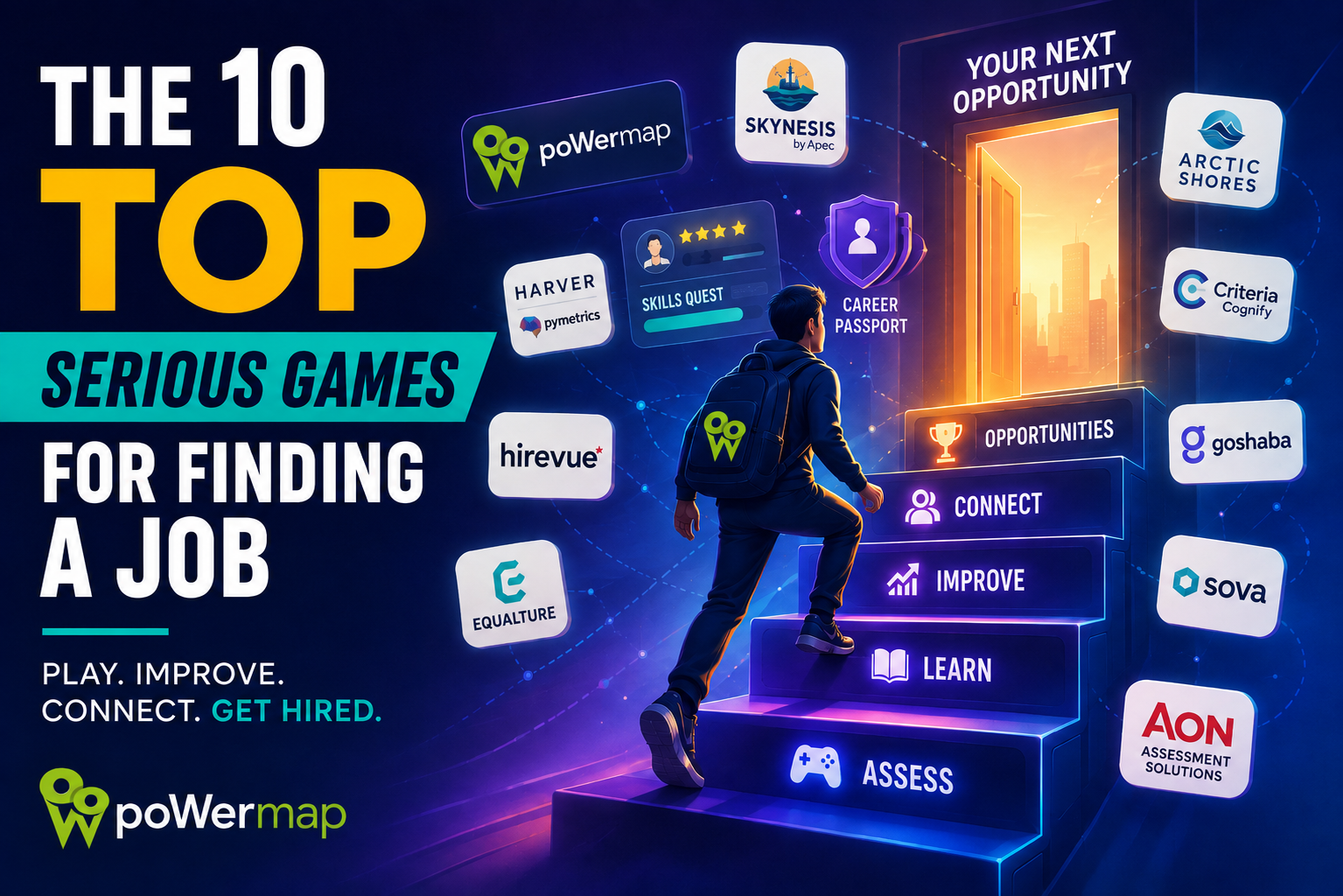
Finding a job is usually treated as a process.
Search. Apply. Upload a resume. Write a cover letter. Wait. Interview. Repeat.
But what if finding a job could become a game?
Gamification is progressively changing recruitment and career development. Serious games, cognitive challenges, simulations, AI recruiters and gamified assessments are being used to help candidates discover their strengths, prepare for interviews, demonstrate potential and sometimes even identify new career opportunities.
There is, however, an important distinction to make.
Most “recruitment games” are actually designed for employers. Candidates only play them after applying for a specific job. The employer owns the process, selects the assessment and receives the results.
A much smaller category takes the opposite approach: giving individuals tools they can use proactively to improve their profile, understand their skills, strengthen their network and create opportunities before they even apply for a job.
That distinction is becoming increasingly important.
In an employment market flooded with resumes and AI-generated applications, simply sending more applications may no longer be the best strategy. Recent reporting has highlighted how recruiters can receive enormous numbers of applications for a single role, increasing the value of differentiation, verified capabilities and professional relationships.
This guide compares ten of the most interesting serious-game and gamified recruitment platforms available or active in 2026.
Organize your contacts, profiles, and personal brand in one app built for the new multi-identity economy.

The ratings above reflect the platforms' usefulness from two different perspectives. B2C measures the value delivered directly to an individual managing their own career. B2B measures usefulness for recruiters, HR teams, schools, employers or talent organizations.
This distinction explains why some extremely sophisticated recruitment technologies receive a lower B2C score: they are powerful tools, but the candidate generally does not control them.
poWermap takes a fundamentally different approach from traditional recruitment games.
Most game-based recruitment platforms ask:
“Are you the right candidate for this particular job?”
poWermap asks a broader question:
“How can you continuously increase the value of your skills, professional identity, reputation and relationships?”
This distinction matters because a career lasts decades, while a recruitment assessment may last only 20 minutes.
poWermap is designed as a relationship intelligence and personal asset management platform connecting professional identities, contacts, resumes, credentials, skills, reputation and opportunities. Its current positioning explicitly treats professional relationships and Human Capital as assets that individuals can organize and develop over time.
One of the concepts at the heart of the poWermap ecosystem is Skills Quest, described by poWermap as an AI-powered career progression game.
Instead of waiting for a real recruiter to reject your application, the concept allows users to challenge different AI recruiter personas.
The user can:
Different recruiter personas can evaluate the same profile according to different expectations, illustrating one of the realities of recruitment: there is rarely one universally “perfect” resume or candidate.
poWermap goes further through another concept called The Mirror.
Professional success is not determined exclusively by what you say about yourself.
It is also influenced by:
The Mirror is designed to transform feedback and relationship data into personal intelligence, helping users better understand their strengths, reputation and interpersonal impact.
This creates something that most traditional assessment games do not provide:
a connection between skills and social capital.
A candidate may have an excellent resume and still struggle to find opportunities because nobody knows that they are looking.
Another professional may obtain an interview through a former colleague, client, manager, university contact or business partner.
poWermap therefore integrates relationship intelligence into career development.
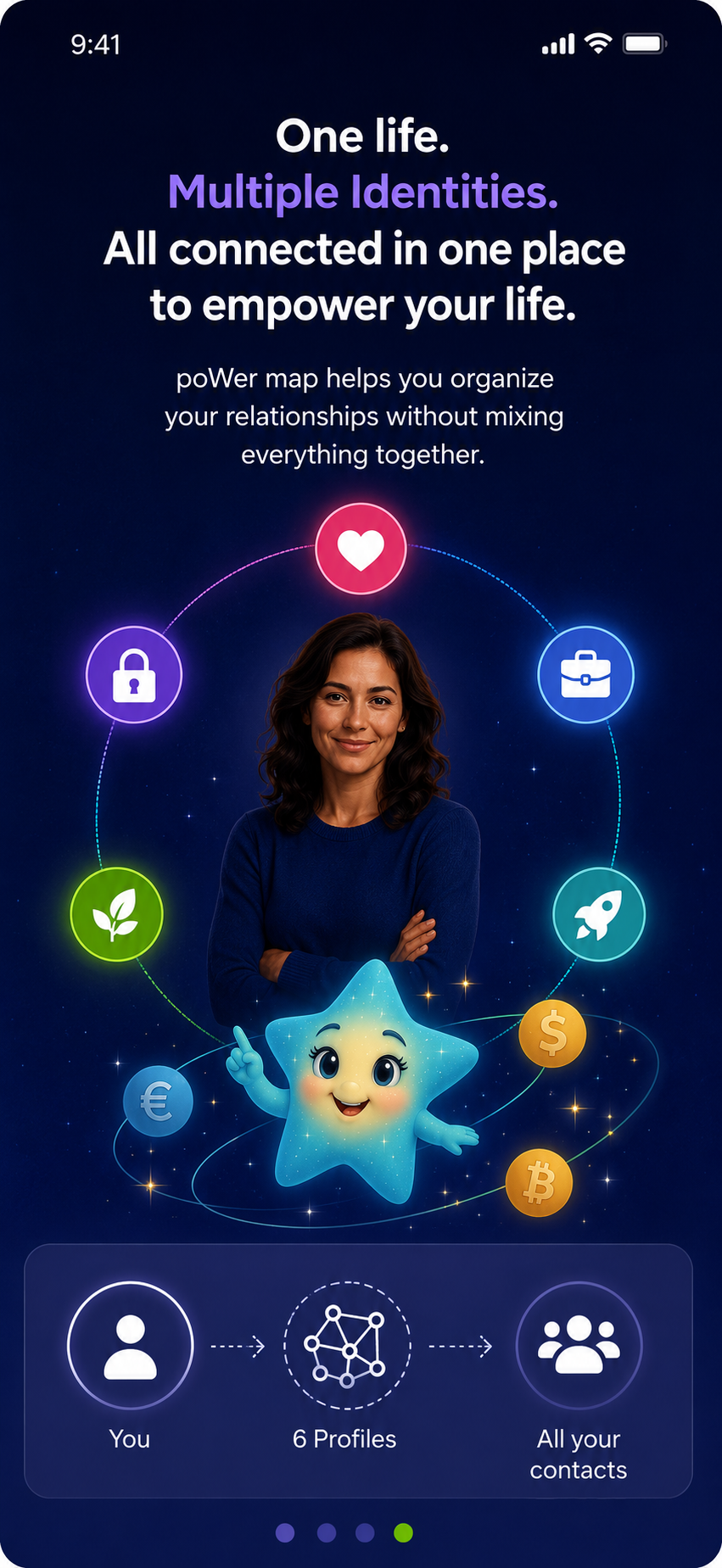
Its Identity Relationship Management model is designed to help users organize networks across several identities, build social capital and identify opportunities ranging from employment and consulting assignments to partnerships, mentoring and collaborations.
That makes the platform particularly relevant for modern professionals who may simultaneously be:
This is arguably poWermap's biggest difference compared with most solutions in this ranking.
With many gamified recruitment platforms:
Employer → sends game → candidate plays → employer receives assessment → process ends.
With poWermap, the intended model is closer to:
Candidate → develops assets → understands strengths → strengthens network → improves profile → activates relationships → discovers opportunities → continues progressing.
The game belongs to the career journey rather than to a single recruitment funnel.
poWermap combines several dimensions that usually exist in separate applications:
Gamified career development + resumes + skills + credentials + multiple professional identities + personal branding + contact management + relationship intelligence + opportunities.
The currently available poWermap Contacts application already focuses on multiple profiles, contact organization and relationship intelligence, while broader skills, resume and career functionality forms part of the expanding poWermap platform and roadmap. The B2C offering also explicitly includes games designed to enrich relationship intelligence.
For companies, poWermap Enterprise extends the model toward resumes, credentials, professional identities and organizational relationship intelligence.
Best for: professionals who want to build career capital continuously rather than simply pass the next recruitment test.
With our mobile app Power Map Contacts, organize your contacts, profiles, and identities in one app built for the multi-identity world.
Create personal, professional, or private profiles. Map your network. Take control of your personal brand.
Skynesis is probably one of the purest examples of a genuine job-search serious game in this ranking.
Created by Apec with Makma and Ikoï Studio, the mobile experience combines an adventure RPG with career coaching for graduates entering the employment market.
Players explore a solarpunk, post-apocalyptic world while learning how to:
The player travels across three archipelagos, meets characters and builds a crew while progressively unlocking practical career resources.
The metaphor is particularly clever: building your crew becomes a way of understanding the importance of building a professional network.
Apec reported that the application had reached approximately 20,000 downloads by the end of February 2026.
Skynesis turns career education into an experience instead of a checklist.
It is particularly valuable for students and recent graduates who may have little understanding of corporate recruitment practices.
Its primary target is first-time job seekers. Experienced professionals, freelancers, executives and multi-career workers may need a broader platform.
Best for: graduates preparing to enter the professional world.
Arctic Shores challenges one of the fundamental assumptions of traditional recruitment: that candidates should be judged primarily by what they write about themselves.
Instead of relying heavily on questionnaires, its assessments use interactive tasks to observe behaviour.
Arctic Shores says its assessments examine candidates' natural responses and provide employers with behavioural insights that can complement or replace traditional CV-based screening.
From the candidate perspective, the experience can feel more like completing challenges than sitting a conventional psychometric examination.
Candidates can also receive feedback reports that place their behaviours on different spectrums.
Arctic Shores is particularly interesting for candidates who do not have the most conventional academic or professional background but may have strong underlying potential.
The candidate generally encounters Arctic Shores because an employer has selected it.
You cannot normally decide to use Arctic Shores as your complete personal job-search platform.
Best for: employers that want to evaluate potential beyond conventional CV signals.
pymetrics became well known for applying neuroscience-inspired games to recruitment and is now offered within Harver's assessment ecosystem.
The platform uses interactive experiences to evaluate attributes such as:
Harver presents the approach as a way to identify potential rather than relying exclusively on educational credentials or previous job titles.
For candidates, this can create an opportunity to demonstrate behaviours that may never appear in a resume.
For companies, the technology is particularly relevant when processing large numbers of applicants.
Strong combination of behavioural science, gamification and high-volume recruitment.
Once again, the employer is generally the customer and controls when candidates enter the game.
It helps candidates prove potential, but it does not manage their complete job search or professional network.
Best for: organizations seeking scalable soft-skill and potential assessment.
HireVue has expanded far beyond video interviews.
Its assessment platform now combines several approaches including game-based assessments, structured interviews and virtual job simulations.
HireVue's game-based psychometric assessments are designed to evaluate domains including personality and work style, working with people and working with information.
The result is less a standalone game and more a complete enterprise recruitment infrastructure.
HireVue is particularly powerful when organizations need to process recruitment at scale while combining different types of candidate evidence.
Its game-based assessments are mobile-friendly and can also support internal mobility.
For individual job seekers, HireVue is essentially part of somebody else's recruitment process.
You play when an employer asks you to play.
It is therefore a strong B2B recruitment game platform, but not a career management solution controlled by the individual.
Best for: major employers running structured, high-volume recruitment processes.
Equalture uses short game-based assessments to analyze cognitive abilities and behavioural tendencies.
Instead of asking candidates to describe themselves through questionnaires, the platform analyzes how they actually interact with its games.
Equalture also emphasizes that its game mechanics are difficult for generative AI systems to complete on behalf of applicants—a particularly relevant argument as AI-generated resumes, application answers and cover letters become widespread.
For employers, Equalture can compare candidates against behavioural patterns associated with successful employees in similar roles.
The platform creates an early-stage recruitment signal that is more difficult to optimize artificially than a conventional application form.
It is also designed to create a more engaging candidate experience than lengthy questionnaires.
Its purpose is primarily candidate screening and prediction rather than helping an individual manage their complete career.
Best for: skills-first and high-volume recruitment environments.
Cognify by Criteria transforms cognitive aptitude assessment into three short interactive games.
The assessment examines areas such as:
Criteria describes Cognify as a game-based cognitive assessment that can be completed in approximately ten minutes plus tutorials.
Its games include puzzle and numerical mechanics rather than traditional multiple-choice psychometric questions.
Cognify demonstrates one of the strongest uses of gamification in recruitment: making cognitive testing faster and more engaging.
Cognify answers a relatively narrow question:
How does this candidate perform cognitively?
It does not manage networking, career strategy, personal branding or opportunity discovery.
Best for: recruiters wanting a short game-based cognitive assessment.
French platform Goshaba combines cognitive science, gaming and recruitment assessment.
Its platform offers multiple cognitive tests presented as mini-games and evaluates a broad set of cognitive traits and soft skills.
Unlike many enterprise-only assessment platforms, Goshaba also offers an individual assessment option, making it particularly interesting in a B2C versus B2B comparison.
Candidates can therefore use the experience to better understand some of their cognitive strengths independently of a particular employer.
Its direct-to-individual option gives candidates more control than many recruitment assessment products.
The game format also makes cognitive evaluation more accessible.
The platform remains primarily focused on assessment.
Knowing your cognitive profile can help your career, but it does not automatically create a professional network or connect that insight with a complete opportunity-management system.
Best for: candidates and employers interested in cognitive and soft-skill assessment.
Sova takes a broader approach to digital assessment.
Its platform supports different hiring situations ranging from early-career recruitment to volume hiring and senior leadership.
Among its available assessment formats are gamified and interactive experiences designed to make candidate assessment more engaging.
Rather than forcing employers to use one assessment methodology, Sova can combine different approaches within a broader talent-assessment strategy.
That makes it particularly interesting for complex enterprise recruitment environments.
The platform is much more valuable to an HR department than to an independent job seeker.
The candidate participates in an employer-designed journey rather than building a persistent career asset.
Best for: organizations seeking a configurable digital assessment environment.
Aon has long provided psychometric and digital assessment technologies to large employers.
Its talent acquisition solutions include gamified assessment approaches designed to combine candidate engagement with structured evaluation.
Aon positions its assessments as globally deployable, scientifically grounded solutions for evaluating skills, behaviours and job fit.
Scale, enterprise expertise and the ability to integrate assessments into complex international recruitment programs.
Aon illustrates the fundamental limitation shared by many platforms in this ranking from a B2C perspective:
The serious game belongs to the recruitment process, not to the candidate's career.
Once the recruitment process finishes, the relationship between candidate and assessment usually finishes with it.
Best for: multinational organizations and sophisticated talent acquisition programs.
Comparing these ten solutions reveals that the term “serious game for finding a job” actually covers three different categories.
The best example is Skynesis.
The objective is learning.
Candidates play to understand recruitment, develop confidence, improve their networking approach and prepare for employment.
This category includes:
The objective is primarily assessment.
Candidates play because recruiters want better information about their abilities or behaviours.
This is the territory poWermap is attempting to build.
The objective is not simply learning or assessment.
It is progression.
Your resume, skills, references, reputation, relationships and professional identities become elements of a persistent career ecosystem.
That difference could become increasingly important.
Traditional recruitment relies heavily on declarative information.
Candidates tell employers:
“I am adaptable.”
“I am a leader.”
“I have excellent communication skills.”
“I am good at solving problems.”
Serious games can add another layer:
Show me.
But the next evolution may go further:
Prove it. Improve it. Get it validated. Connect it to your network. And use it to create opportunities.
This is where serious games start merging with professional social networks, AI career assistants, skills platforms and relationship intelligence.
Instead of creating another static professional profile, the future professional network could become dynamic.
Your career becomes something you continuously develop.
Your skills become quests.
Your professional reputation becomes measurable.
Your network becomes a strategic asset.
Your credentials become portable.
Your progress becomes visible.
And opportunities become something you actively unlock rather than simply wait for.
There is also a strategic question behind the rise of serious games:
Who should own the career data generated by the game?
Most recruitment assessment platforms operate primarily through a B2B model.
The company buys the assessment.
The company selects the candidate.
The company defines the job.
The company receives the results.
From the candidate's perspective, the experience starts and ends with one application.
Candidate-centered platforms reverse that logic.
The individual builds a professional asset over time and decides how to use it across employers, clients, projects and professional identities.
poWermap explicitly describes its users as controlling professional and personal data including skills, experiences, certifications, references, relationships, identities and opportunities.
This approach could become particularly relevant in a world of portfolio careers, fractional work, freelancing and multiple professional identities.
There is no single answer.
If you are a young graduate searching for your first position, start with Skynesis.
If an employer asks you to complete an Arctic Shores, HireVue, pymetrics, Equalture, Cognify, Sova or Aon assessment, treat the game as an opportunity to demonstrate capabilities that a resume may not reveal.
If you want to better understand your cognitive abilities independently, Goshaba offers an interesting B2C approach.
But if your objective is larger than passing one recruitment process—if you want to continuously develop your professional identities, skills, reputation, relationships and opportunities—poWermap represents a different model.
It does not consider finding a job to be a one-off event.
It considers your whole career to be the game.
The next generation of professional networks may not look like today's job boards.
They could combine:
The question may therefore change.
Instead of asking:
“Where should I apply?”
professionals may increasingly ask:
“What should I improve, who should I connect with, what can I prove, and which opportunity can I unlock next?”
That is the promise behind the emerging generation of career serious games.
And it may transform job search from an endless succession of applications into something much more powerful:
a lifelong quest to increase the value of your Human Capital and Relationship Capital.


