
September 4, 2026
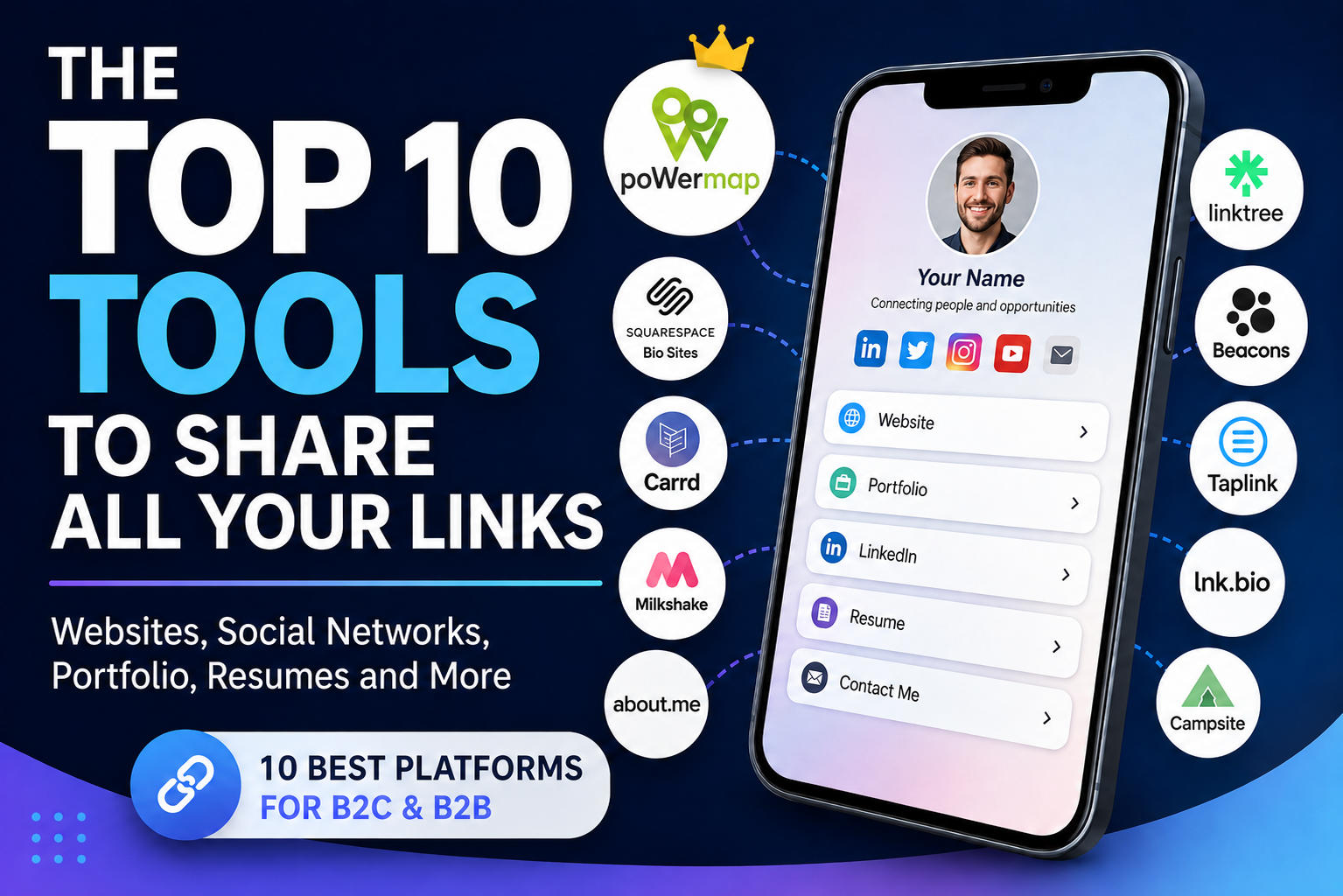
Discover the 10 best tools to share all your links in 2026, from websites and social networks to portfolios, resumes and professional profiles. Compare leading platforms including Linktree, Beacons, Carrd and poWermap, with a focus on both B2C and B2B use cases—and see why poWermap goes beyond link sharing to help manage multiple professional identities, contacts and relationship capital.
Your digital identity is no longer located on a single website.
A professional may have a LinkedIn profile, a personal website, an online resume, a GitHub account, several social networks, a portfolio, a newsletter, a booking page and perhaps a second activity as a freelancer, entrepreneur, creator or advisor.
A creator may need to connect Instagram, TikTok, YouTube, an online store, a podcast, affiliate links and paid content.
A company may need to share corporate websites, product pages, case studies, employee profiles, credentials, contact information and sales resources.
The result is the same: we have more links than places to display them.
This is why “link-in-bio” platforms have become so popular. Instead of sharing ten different URLs, they provide one central address leading visitors to multiple destinations.
Linktree alone says it is used by more than 70 million creators and brands, illustrating how mainstream this model has become.
But in 2026, choosing a link-sharing solution is no longer simply about asking:
“Where can I put all my links?”
The better question is:
“What do I want people to understand and do after clicking my link?”
Some tools focus on creators. Others prioritize ecommerce, visual design, landing pages or analytics.
And a new generation of platforms such as poWermap goes further by connecting links with professional identities, resumes, contacts, credentials and relationship intelligence.
Here are our Top 10 tools for sharing your websites, social networks, portfolio, professional profiles and digital content in 2026.
Organize your contacts, profiles, and personal brand in one app built for the new multi-identity economy.

The scores below are an editorial assessment based on the positioning and capabilities of each platform.
For B2C, we considered ease of use, creator tools, personal branding, social-media integration, design and monetization.
For B2B, we considered professional identity management, lead generation, multiple activities, business content, teams, analytics, customization and the capacity to become part of a broader professional workflow.
Most link-sharing platforms start with the same idea:
One person. One public profile. One page containing many links.
poWermap starts from a different assumption:
One person can have several identities, several audiences and several professional ecosystems.
You might simultaneously be:
Those identities do not necessarily require the same links, the same contacts, the same resume or even the same personal brand.
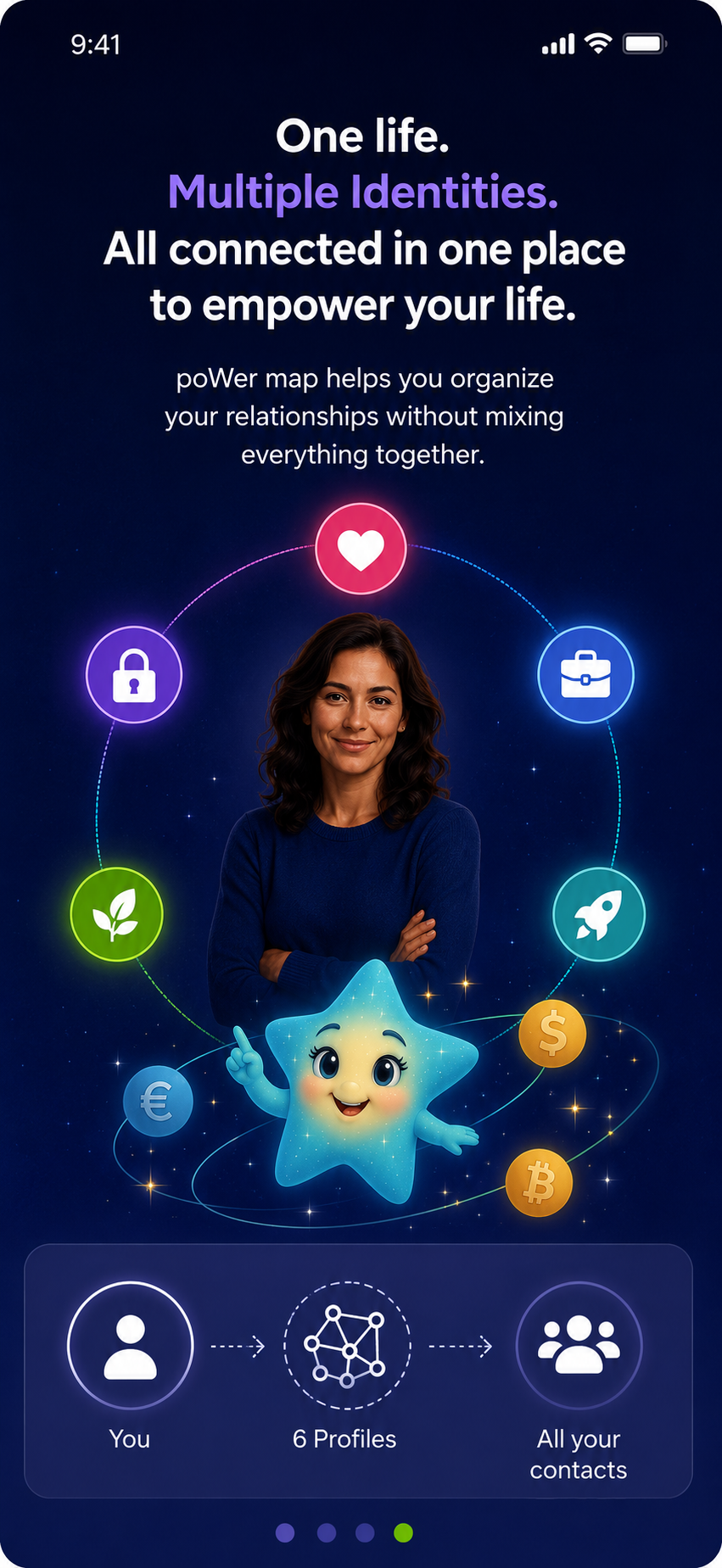
Power Map describes an identity as a distinct version of an individual existing within a particular context, audience or community. Its platform is designed around multiple profiles, contacts, resumes, credentials, skills and relationship intelligence.
That is the fundamental difference between poWermap and conventional link-in-bio platforms.
Linktree, Beacons or Lnk.Bio are excellent when your primary objective is:
“Here is everything I publish online.”
poWermap is particularly relevant when your objective becomes:
“Here is the version of me that is relevant to you.”
A freelance consultant, for example, may want one professional identity connected to:
The same person may have an entrepreneurial identity linked to:
And perhaps a third private or community identity.
Power Map currently allows individual users to manage up to six profiles depending on their plan and specifically positions the platform around separating social networks and identities.
Traditional link-sharing tools primarily manage destinations.
poWermap is designed to manage context.
The link is therefore only one part of a larger digital professional identity that can include:
Power Map calls this broader concept Relationship Intelligence and positions the platform as an environment where professionals can preserve and activate their relationship capital.
This difference becomes even more important for companies.
Consulting companies, recruiters, agencies and professional-services firms do not simply need a collection of links.
They need to know:
Power Map Enterprise is designed around exactly these challenges, combining profiles, resumes, credentials, projects, contacts and relationship data.
Consultants, fractional executives, recruiters, salespeople, founders, advisors, students, freelancers, slashers and professional-services organizations.
poWermap does not simply ask you to centralize your links. It helps you centralize and separate your professional identities.
If your only goal is selling creator merchandise or maximizing affiliate-link conversions, specialized creator platforms such as Beacons or Linktree may currently provide a more mature commerce ecosystem.
But if your links are part of your career, reputation, professional network and personal brand, poWermap offers a fundamentally broader approach.
With our mobile app Power Map Contacts, organize your contacts, profiles, and identities in one app built for the multi-identity world.
Create personal, professional, or private profiles. Map your network. Take control of your personal brand.
Linktree remains the reference point for the entire link-in-bio category.
The proposition is extremely easy to understand:
Create one URL and use it to direct visitors toward all your other destinations.
You can add websites, social profiles, stores, videos, content and other destinations and customize the resulting page.
Linktree now goes considerably further than simple links. Its feature portfolio includes analytics, audience management, forms, booking, digital products, affiliate links, email integrations and other creator-business capabilities.
Its biggest advantage may simply be familiarity.
Many users already understand what they will see when they click a Linktree URL.
For creators and influencers who need to connect Instagram or TikTok with the rest of their ecosystem, it remains one of the easiest choices.
Its analytics can also show views, clicks and traffic sources, helping users understand which destinations perform best.
Linktree organizes your online destinations, but it is not primarily designed to manage several professional identities or relationship networks.
For a creator with one public brand, this is rarely a problem.
For a consultant who is simultaneously an employee, entrepreneur, board member and investor, the model can become more limiting.
Creators, influencers, musicians, solopreneurs and small businesses.
The safest all-purpose choice for traditional link-in-bio requirements.
Beacons positions itself not simply as a link-sharing service but as an all-in-one creator platform.
Its pages can contain:
Beacons also provides email-marketing, store, analytics and creator-business functionality.
Links themselves can be animated, scheduled and individually tracked.
Beacons is particularly interesting when the objective is not merely to redirect an audience somewhere else but to monetize the audience directly.
An influencer can combine personal branding, products, services, mailing-list acquisition and commercial partnerships in the same ecosystem.
Beacons can certainly be used by freelancers and entrepreneurs.
However, its conceptual center of gravity remains the creator economy rather than enterprise relationship management, credentials or professional identity segmentation.
Influencers, content creators, coaches and digital entrepreneurs.
One of the most complete platforms for transforming social-media audiences into revenue.
Taplink sits somewhere between a traditional link-in-bio tool and a mini website or landing-page builder.
Users can add unlimited links alongside text, images, videos, messaging applications and social profiles.
More advanced configurations can include forms, payments, digital products, internal pages, CRM functionality and custom domains.
Taplink is more conversion-oriented than many basic link-sharing applications.
A business can create a page that allows visitors to:
This makes it particularly attractive for freelancers, coaches, local companies and service providers generating leads through Instagram or other social channels.
Taplink can function as a lightweight mobile landing page for individual salespeople, business units or campaigns.
However, it still primarily manages pages and conversions rather than professional identities and relationship capital.
Freelancers, service companies, entrepreneurs and social-commerce businesses.
A powerful bridge between social media, landing pages and lead generation.
Lnk.Bio has evolved far beyond the basic “list of buttons” concept.
Its feature set includes unlimited links, pages, groups, scheduling, statistics, forms, maps, integrations, shops, booking functionality and numerous embed services.
As of May 2026, Lnk.Bio reported support for 147 embed services, 19 major integrations and hundreds of templates.
Its biggest attraction is flexibility.
Users who want to keep adding functionality without leaving their link-in-bio environment will find a substantial toolkit.
Its statistics can include views, link clicks, click-through rates and additional visitor data depending on the plan.
Lnk.Bio is a good compromise for creators, freelancers and small businesses that want more features than a minimalist link page without necessarily building a conventional website.
Creators and professionals who want flexible link management and extensive integrations.
An unusually broad feature set for a dedicated link-in-bio service.
Campsite.bio combines link sharing with more sophisticated marketing functionality.
Beyond normal links, users can incorporate:
It also offers link scheduling and different analytics capabilities according to the selected plan.
Higher-tier capabilities include integrations with tools such as Google Analytics and advertising pixels, while organization-oriented plans support broader usage.
It is particularly appealing to people who see their link page as part of a marketing funnel.
The ability to collect information, embed content and analyze clicks makes the page useful beyond simple redirection.
Marketing professionals, creators, agencies and social-media teams.
A strong combination of links, content, lead capture and analytics.
Squarespace's Bio Sites brings the company's strong design heritage into the link-in-bio category.
Squarespace describes Bio Sites as mini websites designed specifically for social-media use.
Users can add unlimited links and connect websites, products and social networks while using customizable templates. The platform also supports functions such as selling digital products, client bookings, affiliate activities and tips.
Some link-in-bio tools still look like collections of buttons.
Bio Sites feels closer to a compact branded website.
For photographers, designers, artists, architects and visually oriented entrepreneurs, this can make an important difference.
It can work very effectively as a public presentation layer for a freelancer or small business.
However, it does not attempt to manage contacts, professional networks, resumes or multiple professional identities in the way poWermap does.
Designers, photographers, creators and design-conscious small businesses.
Excellent visual presentation with a natural path toward the broader Squarespace website ecosystem.
Carrd is slightly different from most platforms on this list.
It is primarily a one-page website builder, not a traditional link-in-bio product.
That distinction is also its strength.
Carrd provides templates for profiles, landing pages, portfolios and other single-page experiences.
Instead of accepting the standard structure of a link page, users can create their own page hierarchy and combine text, images, buttons, portfolio elements and other components.
Paid functionality can extend the experience with custom domains, forms, embeds and analytics integrations.
A consultant could build a page containing:
It therefore works well as an inexpensive alternative to developing a complete personal website.
Flexibility creates additional work.
With Linktree, you add links.
With Carrd, you are effectively designing a website.
Freelancers, consultants, developers, startups and independent professionals.
Maximum control over a lightweight one-page professional website.
Milkshake takes an original approach to personal websites.
Instead of presenting everything as one vertical list, Milkshake websites are composed of Cards that visitors can swipe through in a way reminiscent of social-media Stories.
Cards can contain text, images, GIFs, YouTube videos, blog content, podcasts, contact information and links. Milkshake also provides statistics for Card views and link clicks.
The experience feels native to the habits of Instagram and TikTok users.
It therefore makes sense for creators whose audiences are overwhelmingly mobile.
The format is much less adapted to enterprise relationship management, professional credentials or complex business identities.
Lifestyle creators, artists, influencers and visually oriented personal brands.
A highly mobile and social-media-native approach to a personal mini website.
about.me is one of the oldest ideas on this list: give every individual a simple place on the Internet explaining who they are.
Its current platform includes personal pages alongside functionality such as portfolios, testimonials, appointment scheduling, contact tools, custom domains and analytics depending on the plan.
The platform has even introduced an AI-powered “Virtual Twin” that visitors can interact with to learn more about the profile owner.
There is still value in simplicity.
Not everyone wants an ecommerce platform, relationship-intelligence system or advanced website builder.
Some users simply need:
Name + picture + biography + professional proposition + links + contact.
about.me does that well.
Executives, freelancers, advisors, speakers and professionals wanting a simple personal homepage.
A straightforward professional introduction rather than a social-media-style link list.
There is no universal winner because these platforms increasingly solve different problems.
You want the most recognizable and straightforward all-purpose link-in-bio solution.
You are a creator and want to monetize your audience.
You want social-media traffic to generate leads, conversations and sales.
You want a large number of link-management functions and integrations.
Analytics, marketing integrations and lead capture matter to you.
Design and visual branding are priorities.
You want to build a true mini website rather than a standard link page.
Your audience is highly mobile and you want a visual, swipe-oriented experience.
You need a clean and simple professional homepage.
You are not simply managing links.
You are managing identities.
For more than a decade, the objective of link-sharing tools was simple:
Put the Internet behind one link.
But professional life is changing.
The same person can now be simultaneously:
Employee / Consultant / Entrepreneur / Creator / Investor / Advisor / Community Member.
The question is therefore no longer just how many links we have.
It is which identity those links belong to.
This is where the next generation of professional platforms may differentiate itself from traditional link-in-bio services.
A website link is useful.
A LinkedIn profile is useful.
A portfolio is useful.
A resume is useful.
A customer reference is useful.
A professional contact is useful.
But their value increases when they become parts of the same coherent professional identity.
That is the direction behind poWermap's approach to Identity Relationship Management: organizing identities, relationships and professional assets rather than treating every profile and URL as an isolated piece of information.
Sharing links may appear to be a small digital problem.
It is becoming a much bigger one.
Your links increasingly represent access to:
The first generation of link-in-bio platforms helped us put many links behind one URL.
The next generation may need to help us put many identities behind one person.
For creators whose primary objective is audience monetization, platforms such as Linktree and Beacons remain extremely powerful.
For businesses focused on conversion, Taplink provides an impressive toolkit.
For professionals whose careers increasingly cross multiple companies, projects, communities and identities, however, a simple list of links may no longer be enough.
Your digital identity is not a list of URLs.
It is a portfolio of people, relationships, skills, experiences, credentials, content and opportunities.
And that is precisely where poWermap intends to go beyond the traditional link-in-bio.
Create multiple identities.
Separate your social networks.
Organize your contacts.
Manage your professional profiles, resumes and credentials.
Build your relationship capital.
Your links tell people where to find you.
poWermap helps them understand who you are.


