
August 6, 2026
Explore the official Power Map glossary and discover the key concepts shaping the future of Human Capital, Identity Relationship Management (IRM), Career Passports, Social Capital, Human Capital Wallets, Skill Quest, The Mirror, and the Multi-Identity Economy.
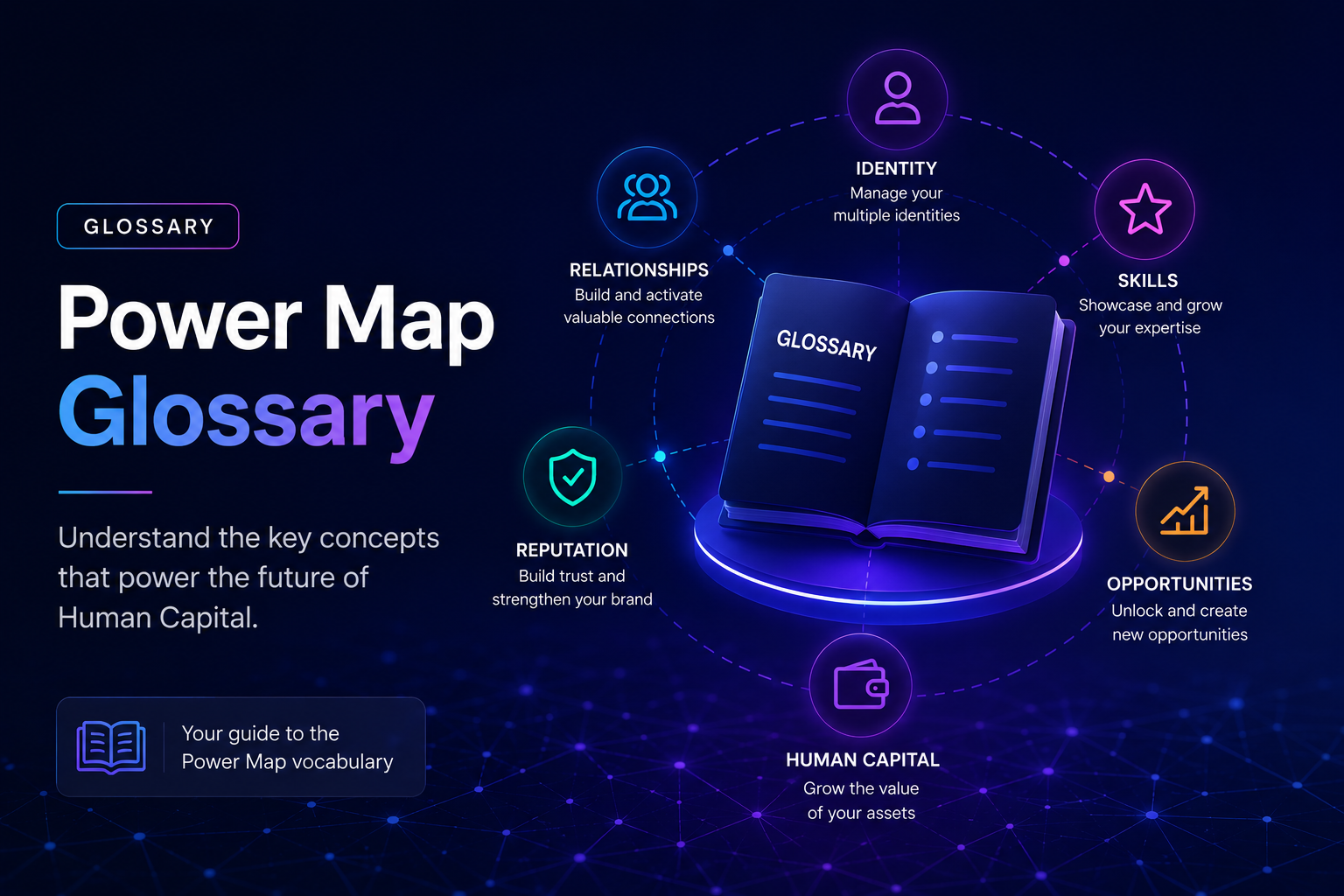
Organize your contacts, profiles, and personal brand in one app built for the new multi-identity economy.

The poWer Map Value (PMV) is the estimated monetary value assigned to a skill, experience, certification, relationship, or other personal asset managed within Power Map.
PMV is designed to help users understand the potential market value of their human capital and professional network.
Before the official launch of the Web3 ecosystem, PMV represents a theoretical value provided for informational purposes only. Once the blockchain ecosystem becomes operational, actual values may fluctuate based on market supply, demand, validation mechanisms, and community adoption.
Management Skills refer to the abilities required to lead people, teams, projects, departments, or organizations effectively.
Examples include:
Management skills help organizations achieve objectives through coordination, decision-making, and leadership.
Communication Skills refer to the ability to convey information clearly, effectively, and appropriately across different audiences and channels.
Examples include:
Strong communication skills enhance collaboration, influence, leadership, and professional effectiveness.
Functional Skills bridge the gap between business expertise and technology implementation.
They enable professionals to translate business requirements into operational processes, software configurations, and information systems.
For example, during an ERP implementation project, a functional consultant may transform accounting requirements into system configurations, workflows, screens, reports, and validation procedures.
Examples include:
Functional skills are essential for ensuring that technology solutions effectively support business objectives.
Technical Skills refer to the specialized knowledge and practical abilities required to design, develop, implement, maintain, or operate technological solutions.
Examples include:
Technical skills are often acquired through education, certifications, professional experience, and continuous learning.
Values represent the personal beliefs, principles, and ethical foundations that guide an individual's decisions and behaviors.
Power Map includes values as a matching criterion to help individuals connect with opportunities, organizations, communities, and projects that align with their personal convictions.
Examples include:
Like all personal data within the Power ecosystem, values may be securely managed and validated through blockchain technologies.
Skills are rated on a scale from 0 to 4 within Power Map.
The user has theoretical knowledge but limited or no practical experience.
The user has completed an initial project or acquired first practical experience.
The user demonstrates consistent and autonomous application of the skill.
The user possesses significant experience and can mentor or guide others.
The user is recognized as a leading authority with deep expertise and proven achievements.
Skills may be certified or non-certified.
Certified Skills are skills supported by an official certificate, diploma, accreditation, badge, or recognized professional credential.
To obtain certified status within Power Map, users must upload the relevant supporting documentation for validation.
Certified skills provide greater credibility and improve matching accuracy for opportunities, projects, and professional engagements.
Skills Categories are classification structures used to organize skills into logical groups.
They improve searchability, reporting, matching algorithms, user experience, and portfolio presentation.
Examples include:
A single skill may belong to multiple categories.
An Offer represents a strategic positioning, market proposition, or editorial framework used to organize professional content within Power Map.
Offers help users structure:
An offer defines how a professional presents their expertise to a target audience and influences which information should be emphasized, minimized, or excluded.
Examples include:
Offers help maximize the marketing, sales, and career impact of a user's professional profile.
With our mobile app Power Map Contacts, organize your contacts, profiles, and identities in one app built for the multi-identity world.
Create personal, professional, or private profiles. Map your network. Take control of your personal brand.
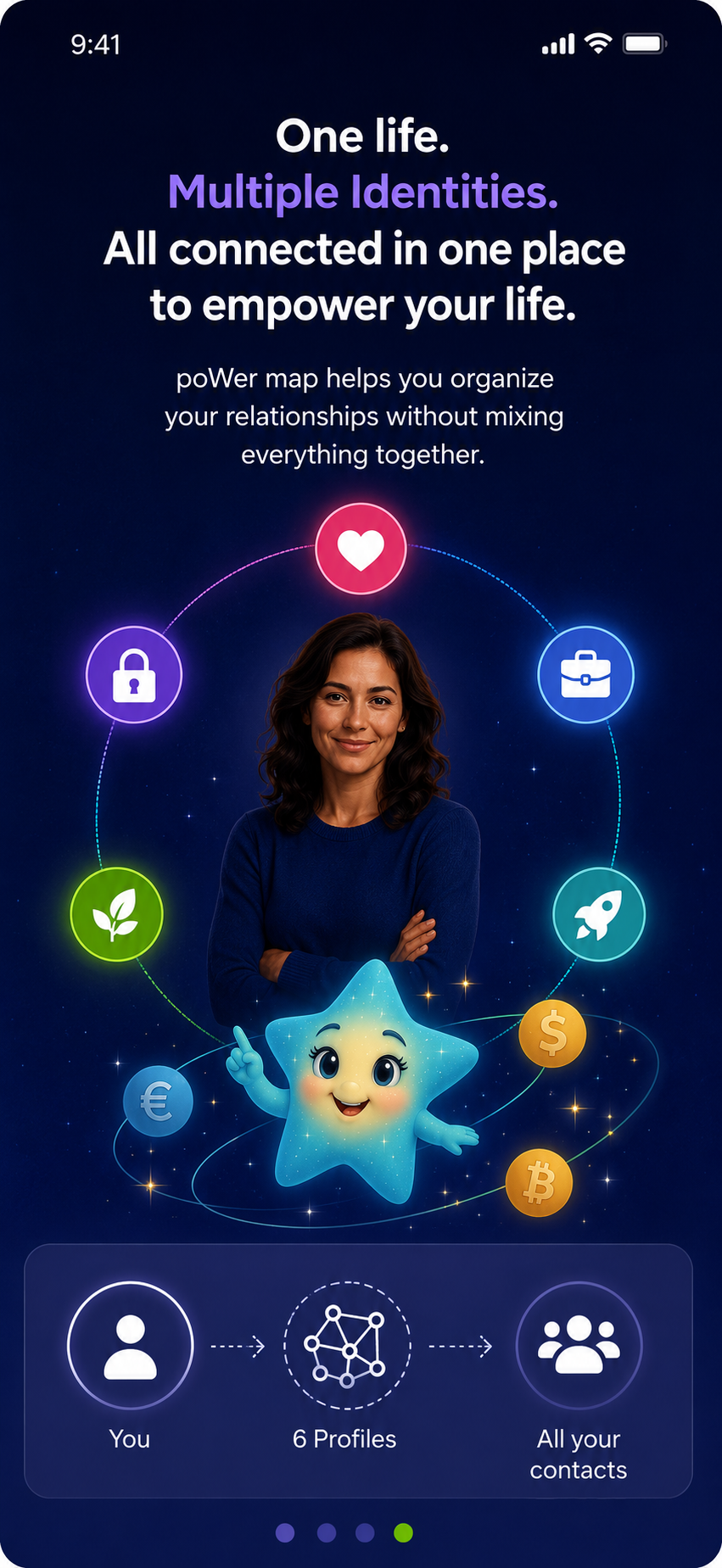
An Identity is a distinct version of an individual that exists within a specific context, audience, or community.
Examples include:
Each identity may have its own relationships, reputation, content, opportunities, and objectives.
Identity Relationship Management (IRM) is the discipline of organizing, protecting, understanding, and activating relationships across multiple identities.
IRM extends traditional contact management by recognizing that individuals often operate through multiple personal, professional, and public identities simultaneously.
IRM enables users to:
Power Map is designed around the principles of Identity Relationship Management.
Social Capital represents the collective value of an individual's relationships, network, trust, reputation, and influence.
In Power Map, social capital is considered a strategic asset that can generate opportunities, learning, partnerships, referrals, and career growth.
An Opportunity is any professional, personal, educational, financial, or community-driven possibility that may create value for the user.
Examples include:
Power Map helps users identify, track, and activate opportunities across all their identities.
A Career Passport is a verified credential that demonstrates expertise, achievements, and capabilities within a specific professional domain.
Career Passports are designed to make competencies visible, portable, and understandable across industries and geographies.
Examples include:
Career Passports may be earned through:
They serve as trusted indicators of professional capability.
Human Capital represents the total value of an individual's knowledge, skills, experiences, certifications, achievements, relationships, and potential.
Power Map's mission is to help users understand, grow, showcase, and monetize their human capital throughout their professional journey.
The Mirror is Power Map's relationship intelligence engine.
Its purpose is to help users better understand how they are perceived by the people around them.
Through evaluations, feedback mechanisms, and relationship insights, The Mirror provides a more objective view of an individual's strengths, reputation, influence, and interpersonal impact.
The Mirror helps answer questions such as:
The Mirror transforms subjective perception into actionable personal intelligence.
Skills Quest is Power Map's AI-powered career progression game.
The objective of Skills Quest is to help users improve their professional profile, increase their market value, and unlock new Career Passports.
Within Skills Quest, users can:
Each recruiter persona evaluates candidates according to different criteria, reflecting real-world hiring expectations.
Skills Quest transforms career development into an engaging, measurable, and rewarding experience.
A Power Mapper is an individual who uses Power Map to manage, develop, showcase, and activate their human capital.
Power Mappers may be employees, consultants, entrepreneurs, freelancers, creators, students, investors, executives, or community leaders.
A Power Mapper owns and controls their professional and personal data, including:
The mission of every Power Mapper is to continuously increase the value of their Human Capital Wallet and unlock new opportunities throughout their career journey.


