
August 6, 2026
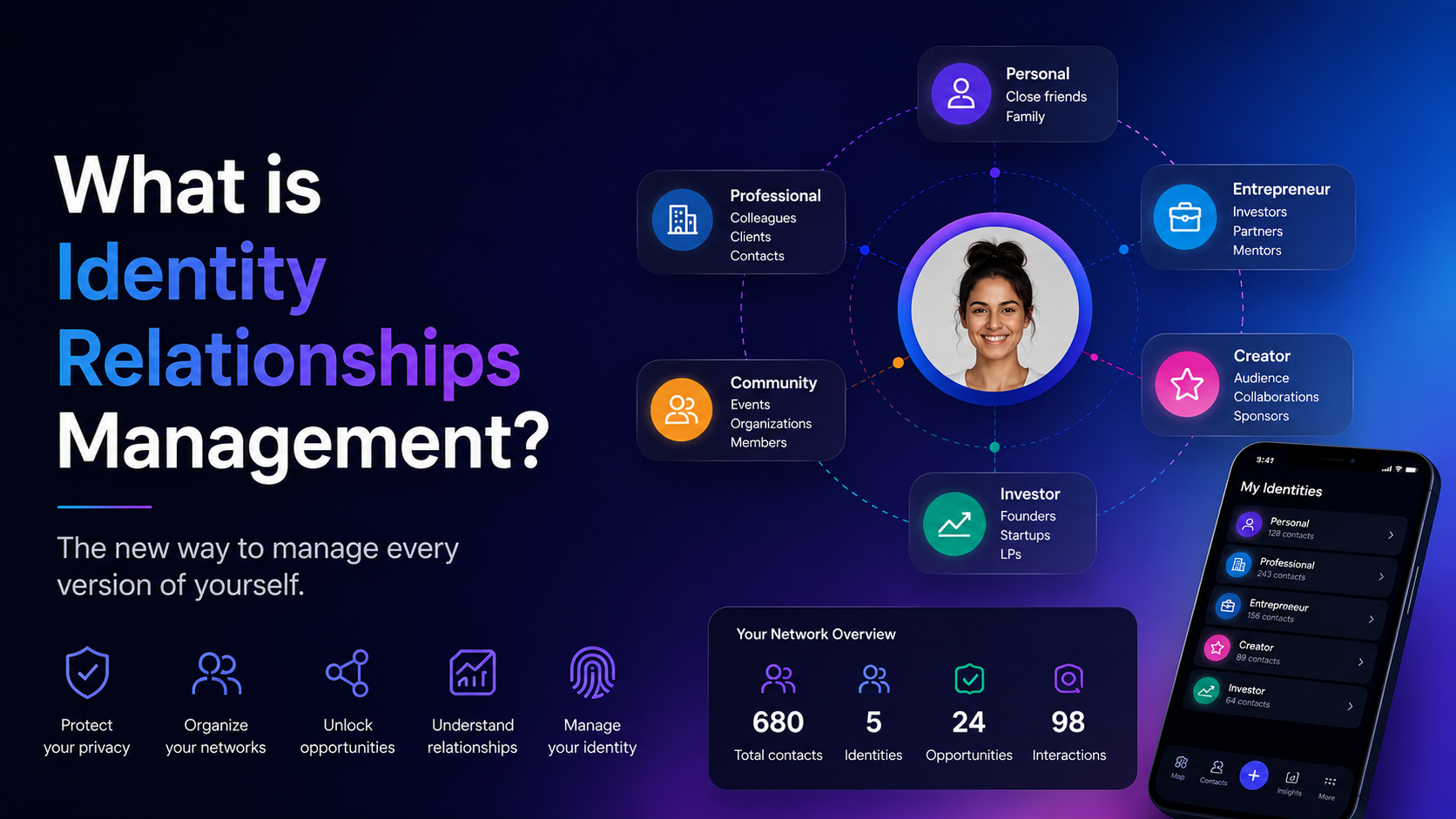
Identity Relationship Management (IRM) is the next evolution of networking. Discover how individuals can organize, protect, and grow relationships across multiple identities, from professional and personal lives to creator and entrepreneurial activities.
For more than 40 years, businesses have relied on Customer Relationship Management (CRM) systems to organize their most valuable asset: customer relationships.
Sales teams use CRM platforms to track prospects.
Marketing teams use CRM platforms to nurture audiences.
Executives use CRM platforms to understand business opportunities.
The underlying assumption is simple:
Relationships create value.
But what happens when the individual—not the company—becomes the center of the economy?
What happens when millions of people simultaneously operate as employees, creators, entrepreneurs, investors, community leaders, freelancers, influencers, and public personalities?
What happens when a single person manages multiple identities, multiple networks, and multiple reputations?
The answer is that CRM is no longer enough.
We need a new category.
We need Identity Relationship Management.
The average knowledge worker in 2026 maintains relationships across dozens of contexts.
They may be:
Each role comes with its own network.
Each network contains different people.
Each network creates different opportunities.
And each network expects a different version of that person.
The challenge is not managing contacts.
The challenge is managing identities.
Yet most digital tools still assume people have only one professional life.
They don't.
Organize your contacts, profiles, and personal brand in one app built for the new multi-identity economy.

CRM asks:
"How can a company manage relationships with customers?"
IRM asks:
"How can an individual manage relationships across multiple identities?"
This distinction is subtle.
But it changes everything.
CRM focuses on external relationships.
IRM focuses on identity-centered relationships.
CRM sees contacts.
IRM sees contexts.
CRM sees customers.
IRM sees networks.
CRM is built for organizations.
IRM is built for individuals.
Identity Relationship Management (IRM) is the discipline of organizing, protecting, understanding, and activating relationships across multiple personal, professional, and public identities.
An IRM platform enables individuals to:
IRM recognizes a simple reality:
People no longer live under a single identity.
Historically, multiple identities were mostly associated with celebrities.
Lady Gaga was Stefani Germanotta.
The Weeknd was Abel Tesfaye.
Eminem was Marshall Mathers.
A stage name created a separation between public life and private life.
Today, the same phenomenon exists everywhere.
A software engineer may also run a YouTube channel.
A teacher may be a podcaster.
A consultant may be an angel investor.
A student may be an influencer.
A doctor may lead a nonprofit.
The Multi-Identity Economy has transformed identity itself into an asset.
And assets require management.
Most contact-management applications were designed decades ago.
Their underlying model is simple:
Person A knows Person B.
But reality is more complex.
Consider Sarah.
Sarah is:
The same contact may play different roles depending on which identity Sarah is activating.
Traditional contact managers cannot understand this complexity.
They store names.
They do not understand identities.
They do not understand context.
They do not understand reputation.
They do not understand relationship value.
With our mobile app Power Map Contacts, organize your contacts, profiles, and identities in one app built for the multi-identity world.
Create personal, professional, or private profiles. Map your network. Take control of your personal brand.
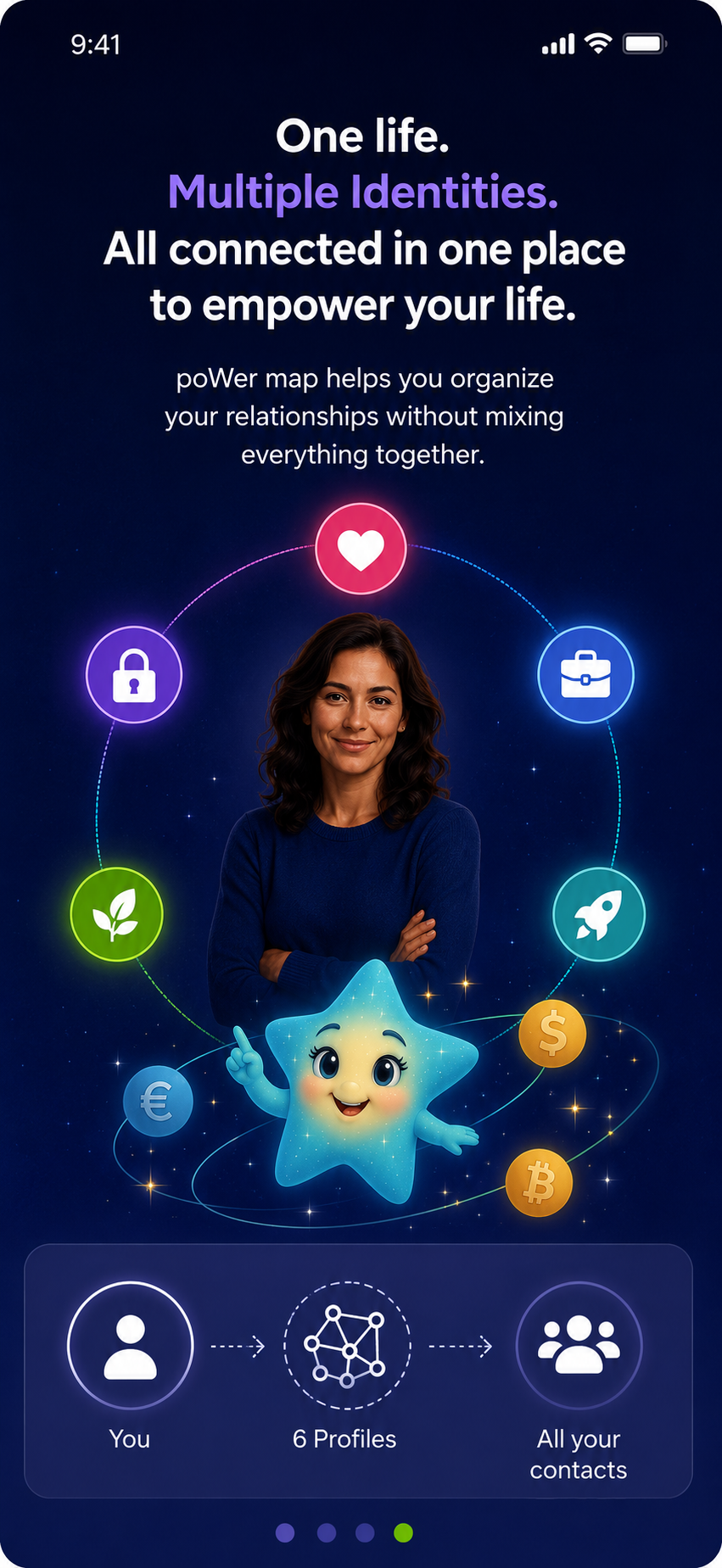
The first challenge is separating identities.
People need the ability to distinguish:
Without separation, networks become chaotic.
Privacy has become one of the most valuable resources of the digital age.
IRM enables individuals to control which identity is visible to which audience.
The future of networking is selective visibility.
Not universal exposure.
Not all relationships are equal.
Some relationships generate opportunities.
Some generate trust.
Some generate learning.
Some generate influence.
IRM helps individuals understand their social capital.
Opportunities rarely emerge from strangers.
They emerge from networks.
The stronger the network structure, the greater the opportunity flow.
IRM helps reveal hidden opportunities across identities.
Every identity develops its own reputation.
A person's professional reputation may differ significantly from their creator reputation.
IRM helps individuals monitor, grow, and protect those reputational assets.
Generation Alpha is growing up in a world where identity is fluid.
Many young people already maintain separate identities across:
For them, identity fragmentation is normal.
Managing multiple identities will become a core life skill.
Just as digital literacy became essential in the early internet era, identity literacy may become essential in the AI era.
Artificial intelligence will dramatically increase the number of identities people manage.
In the coming years, individuals may operate:
Each will generate relationships.
Each will require governance.
Each will require trust.
The number of relationships attached to a single individual may increase by an order of magnitude.
This makes Identity Relationship Management not merely useful.
It makes it necessary.
For centuries, wealth was measured through physical assets.
Then came financial assets.
Then intellectual assets.
The next frontier may be identity assets.
The quality of your networks.
The strength of your reputation.
The diversity of your communities.
The opportunities attached to your identities.
These assets already influence careers, businesses, investments, and social mobility.
IRM provides a framework for understanding and managing them.
Customer Relationship Management transformed business.
Identity Relationship Management may transform personal and professional life.
As the world becomes more connected, more digital, and more fragmented, individuals will increasingly need tools to manage not just contacts—but identities.
The future belongs to people who can effectively organize, protect, and activate the networks attached to every version of themselves.
Because in the emerging Multi-Identity Economy, your most valuable asset is no longer simply who you know.
It is how you manage who you are.


